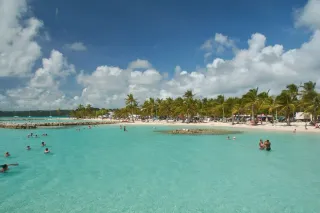

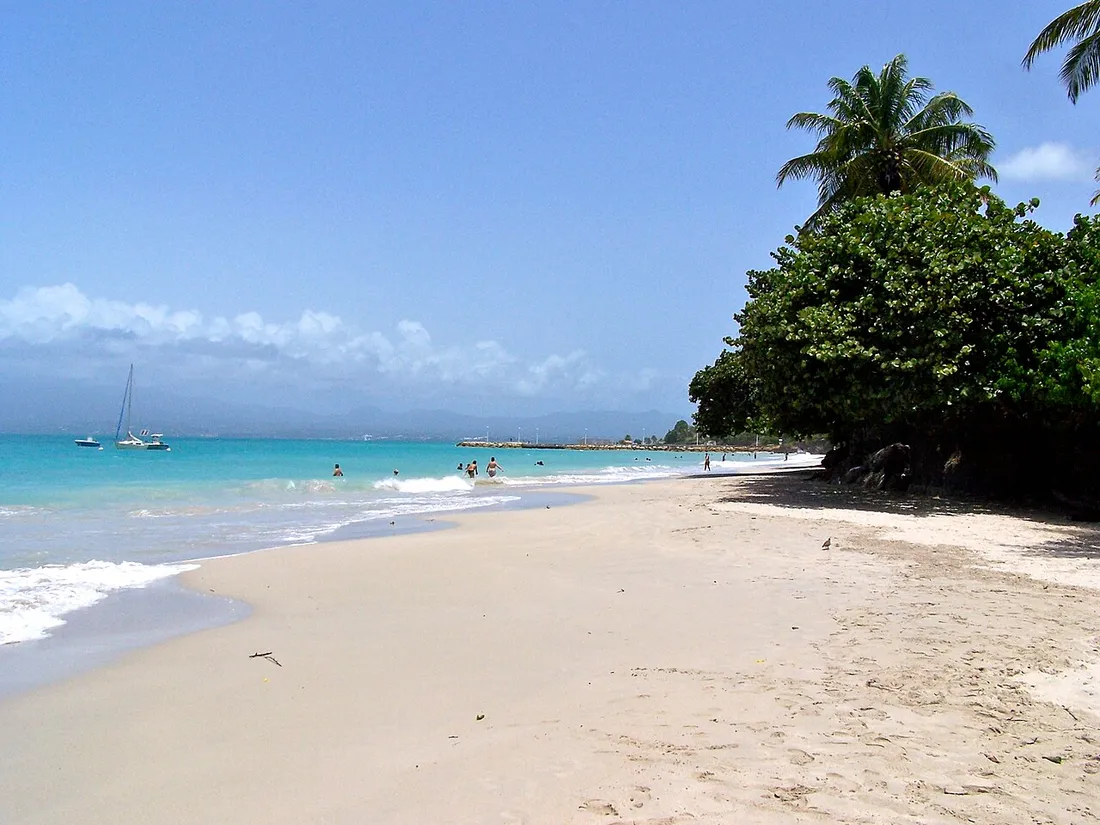
Short-term rentals in Le Gosier make a lot of owners dream, and it’s easy to see why. The Bas-du-Fort marina, La Datcha beach, the Îlet du Gosier just 600 metres offshore, and the Pôle Caraïbes airport 15 minutes away: the town is one of the most dynamic tourist markets in Grande-Terre. A well-managed sea-view one-bedroom rents here for €75 to €110 a night in the dry season (December to April), with occupancy rates often topping 80% from January to March. But Le Gosier has a particularity that Sainte-Anne and Deshaies don’t share to the same degree: it’s a dense, urban town where most of the housing stock sits within co-ownership buildings. And that’s exactly where the trouble begins for poorly informed owners.
After several years supporting owners in the town, we’ve seen both scenarios: those who secured their project upfront, and those who received a registered letter from the building manager or the town hall after six months of activity. Here’s what you need to check before publishing your first listing.
Short-term rentals in Le Gosier: what the regulations say
Primary or secondary residence: the distinction that changes everything
First instinct: determine your property’s status.
- Primary residence (you occupy it at least 8 months a year): you can rent it as a furnished tourist let for a maximum of 120 days per year (this cap can be lowered to 90 days by municipal decision). A simple town-hall declaration is enough in most cases.
- Secondary residence or investment property: this is the most common case in Le Gosier, particularly in the Bas-du-Fort, Mare-Gaillard or Grande-Ravine developments. Here there’s no day limit, but heavier administrative obligations, potentially including a change of use.
Town-hall registration and the registration number
In all cases, renting a furnished tourist let must be declared at the Le Gosier town hall (Cerfa form no. 14004). Since the law of 19 November 2024 (the “Le Meur law”), the registration procedure with a 13-character number is being rolled out to every town: this number must appear on each of your listings, on Airbnb as well as Booking. Allow 2 to 4 weeks for processing, and zero euros in fees. Renting without a declaration exposes you to a fine of up to €5,000.
On top of this comes the tourist tax, collected from travellers: roughly €0.65 to €1.50 per night per adult depending on the let’s star rating. The platforms generally collect it automatically; with direct bookings, it’s up to you to charge it.
Change of use: the particularity of high-demand towns
This is the least understood point. Le Gosier is among the Guadeloupe towns classified as a high-demand zone, where year-round housing is under pressure. In this context, the municipality can subject the conversion of a home into a furnished tourist let to a change-of-use authorisation, and may even introduce a quota per neighbourhood (the November 2024 law also allows certain sectors to be reserved for primary residence in the local urban plan).
In practice, for a secondary residence in Le Gosier:
- check with the town hall’s urban-planning department whether a decision on change of use is in force and which zones it covers;
- if authorisation is required, file your application before you start renting: it is often temporary, renewable, and attached to the person, not the property;
- keep written proof of the town hall’s response, even if you are not subject to the rule.
Renting without authorisation where it is required is a civil fine of up to €50,000 per property. This is not theoretical: tourist towns have tightened their controls since 2024, cross-checking online listings against tax records.
Co-ownership bylaws: the lock many people forget
The “bourgeois residence” clause, a classic trap in Le Gosier buildings
Even with all your paperwork in order on the town-hall side, your co-ownership can legally forbid seasonal rentals. In Le Gosier, where developments from the 1980s-2000s dominate (Bas-du-Fort foremost, with its large co-ownerships around the marina), three situations arise:
- Simple “bourgeois residence” clause: commercial activities are prohibited, but furnished tourist letting remains possible in principle as long as it doesn’t create a nuisance. This is the most favourable case.
- Exclusive “bourgeois residence” clause: only residential use is permitted. Case law mostly holds that repeated short-term renting is incompatible with it. If your bylaws contain this clause, the project is blocked unless the bylaws are amended (a majority that is very hard to obtain).
- Express clause on furnished tourist lets: since the 2024 law, co-ownerships can rule explicitly, and a ban on new furnished tourist lets can be voted by a two-thirds majority (Article 26), no longer unanimously. General meetings must now put the question on the agenda: keep an eye on your meeting notices.
The right reflexes before buying or renting
- Ask the building manager or notary for the co-ownership bylaws before any rental purchase in Le Gosier: reading the use clauses takes 30 minutes and can save you a €10,000 legal-fee procedure.
- Re-read the last three AGM minutes: a resolution hostile to seasonal rentals, even if rejected, signals a tense climate.
- Inform the building manager of your activity (this is now a mandatory declaration) and provide a reachable contact in case of a problem: a neighbour who has the manager’s WhatsApp number calls before writing to the building manager.
- Frame your travellers: a welcome book with a reminder of the bylaws (pool closed at 10 p.m., no noise on the walkways), a ban on parties, a systematic security deposit. 90% of co-ownership conflicts arise from noise and parking.