
When people talk about diving in Guadeloupe, everyone pictures the coral gardens of the Îlets Pigeon. But near the Cousteau Reserve, two deliberately scuttled ships lie waiting, offering the most memorable dives on the leeward coast: the Franjack and the Augustin Fresnel. If you’re looking for an accessible, fish-filled wreck dive in Guadeloupe, these two ships resting on the sand off Malendure (Bouillante) tick every box. I dive them several times a year, and every descent has a surprise in store: patrolling barracudas, a turtle tucked under the hull, a green moray settled into the wheelhouse. Here are the real depths, required certification, budget and marine life to plan these dives on the Basse-Terre side.
Why dive a wreck in Guadeloupe rather than anywhere else?
The Caribbean has dozens of wrecks, but those in Guadeloupe combine three rarely paired advantages:
- Deliberate, safe dives: both ships were decontaminated and then scuttled on purpose to create artificial reefs. No treacherous metal sheets or ghost nets.
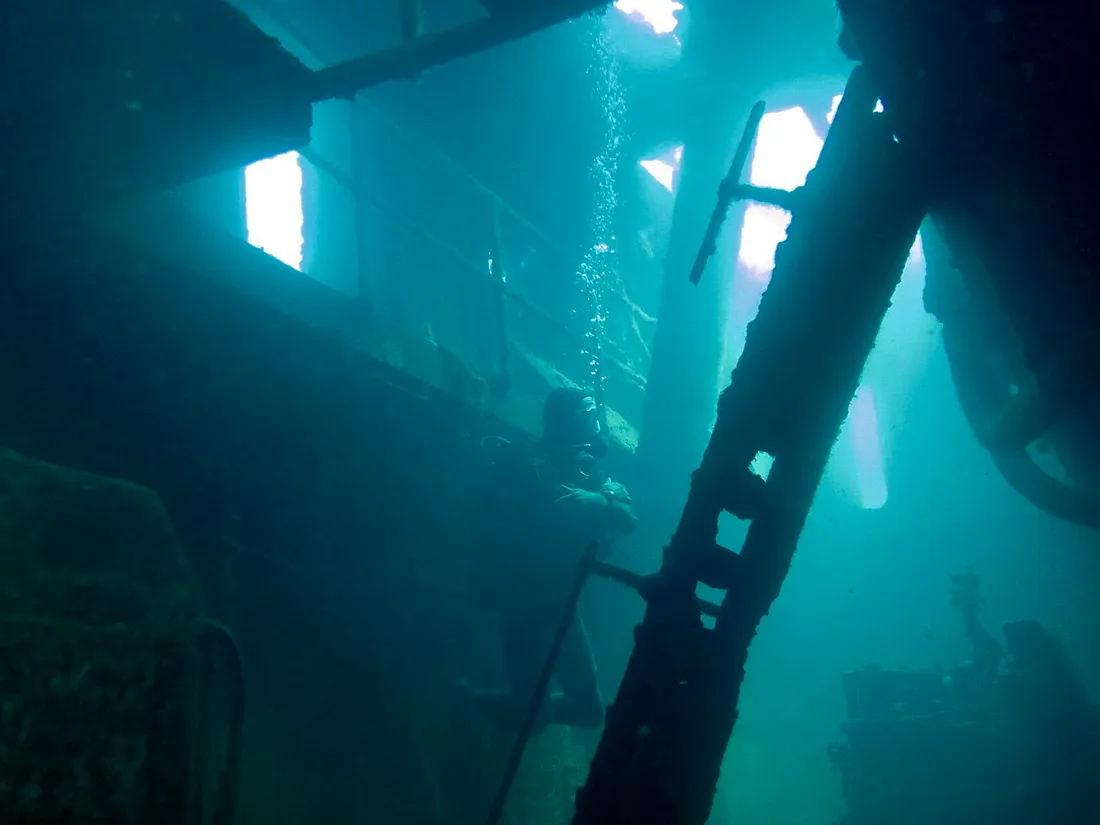
- Spectacular colonization: after twenty to thirty years underwater, the structures are coated with orange and purple encrusting sponges, sea fans and hard corals. You’re diving a reef shaped like a ship.
- Unbeatable logistics: both sites are 5 to 10 minutes’ sailing from Malendure beach. You can dive a wreck in the morning and the coral gardens of the Cousteau Reserve in the afternoon.
The west coast of Basse-Terre is sheltered from the trade winds: water at 26-29 °C year-round, visibility of 15 to 25 metres, and generally weak current. The dry season (December to April) offers the most stable conditions, but you can dive here all year.

The Franjack wreck: the star, accessible from Level 1 with a guide
Site fact sheet
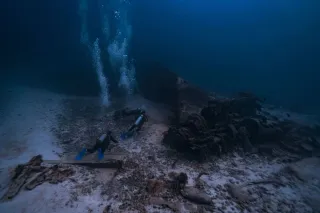
The Franjack is a former sand carrier about fifty metres long, deliberately scuttled in the mid-1990s between Malendure beach and the Îlets Pigeon. It sits upright on its keel on a pale sandy bottom:
- Maximum depth: around 22-24 metres at the sand
- Main deck: about 15-18 metres
- Required level: Level 1 / Open Water with an instructor; independent diving possible from Level 2
- Typical duration: 40 to 50 minutes
- Current: weak to none most of the time
It’s the ideal wreck for a first experience: the ship’s silhouette appears around 10 metres along the descent line, and orientation is obvious on this intact, well-settled vessel.
What you’ll see
Life has literally exploded on the Franjack:
- Schools of soldierfish and grunts massed in the shaded passageways
- Green and spotted morays in the nooks of the hold
- Hawksbill turtles that regularly settle near the hull to rest
- Barracudas in open water above the mast
- French angelfish, trumpetfish, porcupinefish all over the structure
Local instructors often take divers through the open hold, wide and bright: a very gentle “penetration,” perfect for getting a first taste of wreck sensations. Keep an eye on the sand around the ship, the territory of stingrays.
The Augustin Fresnel: the Level 2 wreck, deeper and wilder
A former buoy tender resting at 30 metres
The Augustin Fresnel owes its name to the physicist who invented lighthouse lenses: this forty-metre vessel was a buoy tender responsible for maintaining the archipelago’s markers. Deliberately scuttled in the early 2000s off Malendure, it perfectly complements the Franjack:
- Maximum depth: around 28-30 metres on the sand
- Deck and superstructures: between 20 and 25 metres
- Required level: Level 2 / Advanced (diving beyond 20 m)
- Typical duration: 35-40 minutes due to the depth
- Atmosphere: darker, more “wreck-like” than the Franjack
The descent into the blue is already a highlight: the dark mass of the tender gradually takes shape, often surrounded by a cloud of glassfish. The bridge and the cargo crane, carpeted with sponges and fire coral, are the most photogenic areas.
Augustin Fresnel: a dive to plan seriously
At 30 metres, no-stop time runs out fast. My rules for this site:
- Dive it as the first dive of the day, with a fresh computer
- Plan a 3-minute safety stop at 5 metres; the mooring line makes the ascent easier
- Level 1? Some clubs run the Level 2 course on site (5 to 6 dives), with the Augustin Fresnel as the “qualifying” dive
- Nitrox, available in Bouillante, usefully extends bottom time