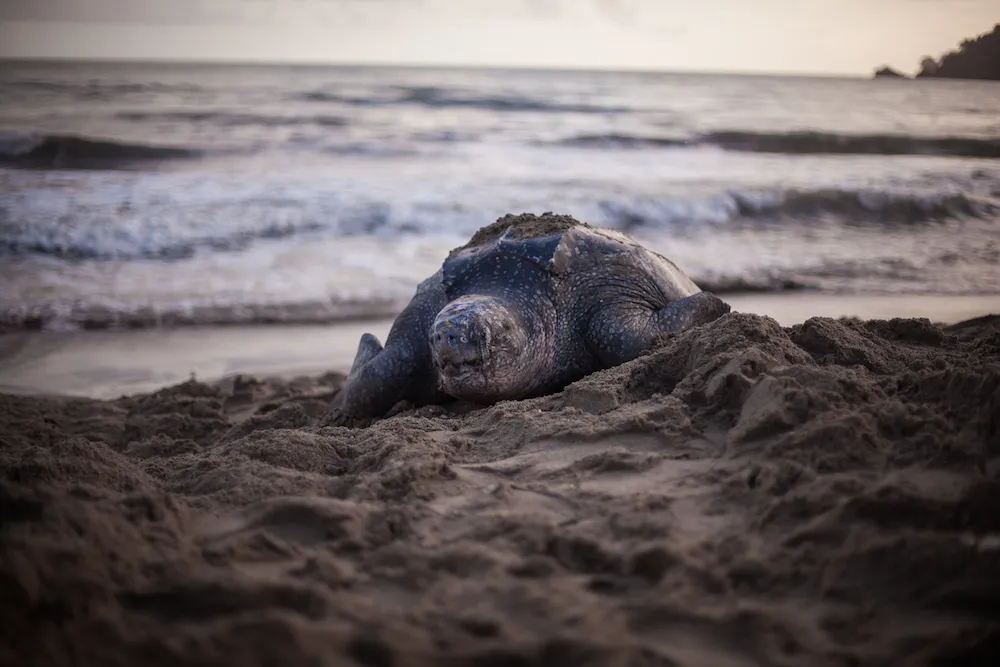
There are few sights as moving as watching, by starlight, a leatherback turtle weighing more than 500 kilos haul herself up from the surf, dig her nest with the sheer force of her flippers for nearly two hours, then return to the Atlantic without a backward glance. I have been guiding travellers along this coast for several years, and every season I feel the same emotion. If you are hesitating to push all the way to the far west of the territory, this article is for you: we will talk about leatherback turtle nesting in French Guiana, the real calendar and the best spots on Hattes Beach, but also how to experience it while respecting the Amerindian site and the animal itself.
Why Awala-Yalimapo is a site unique in the world
Awala-Yalimapo is the westernmost commune of French Guiana, set at the mouth of the Maroni River, facing Suriname. Hattes Beach and Pointe Isère form one of the most important leatherback turtle nesting sites on the planet. A wide strip of sand pounded by the Atlantic and fed with sediment by the Amazon and the Maroni, the beach welcomes hundreds of nesting visits each year. On some peak-season nights, several dozen turtles take turns on the same shoreline.
The commune is a kali’na territory, an Amerindian people whose culture is very much alive. Part of the beach is classified as the Amana National Nature Reserve, which strictly regulates access and observation. So you do not come here as if to a theme park: you are welcomed onto inhabited land, sacred to its people, and that is precisely what makes the experience so powerful.
The leatherback, giant of the oceans
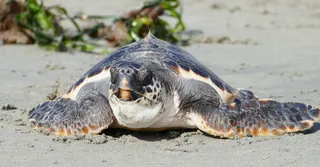
The leatherback turtle (Dermochelys coriacea) is the largest sea turtle in the world and the largest living marine reptile:
- up to 2 metres long and more than 600 kg for the biggest females (often 1.50 to 1.80 m on Guianese beaches);
- a soft, rubbery shell, without hard scales, marked by seven longitudinal ridges that evoke the strings of a lute (luth in French), hence its name;
- a nesting duration of about 1 hour to 1 hour 30 (up to 2 hours for some), for a nest of 80 to 100 fertilised eggs;
- a female may return to nest several times in the same season, about ten days apart.
Three other species also frequent the Guianese coast: the green turtle, the olive ridley and, more rarely, the hawksbill. But the leatherback, the most spectacular, remains the star of Awala.
Nesting calendar: when to come to Awala?
The calendar is the number-one factor for success. Here are the markers I always give:
- March: first nesting visits, still scattered. For the patient.
- April to June: peak of leatherback nesting, with the largest number of females each night, sometimes several at once on the same stretch of beach. This is the prime period.
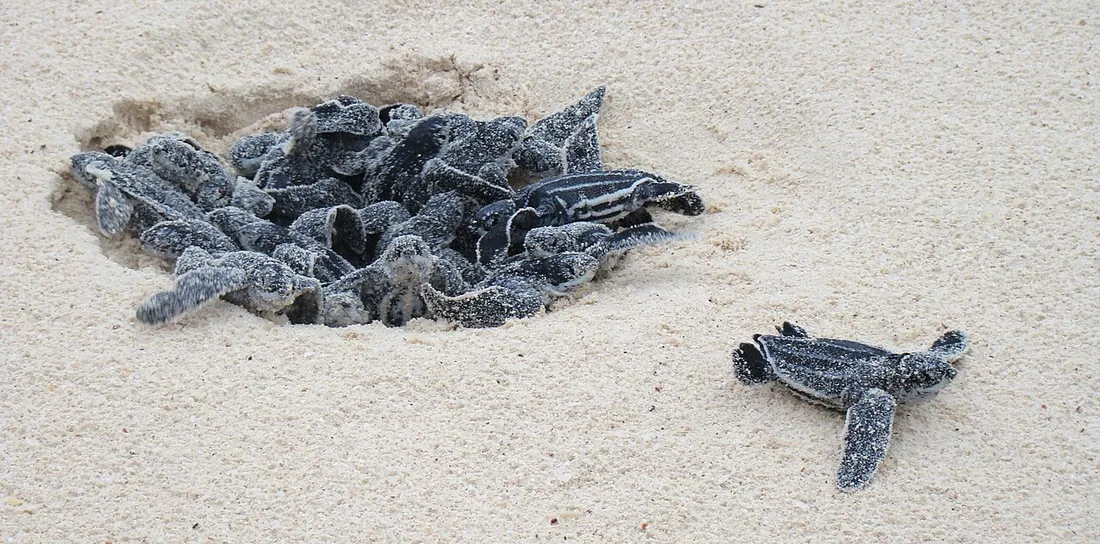
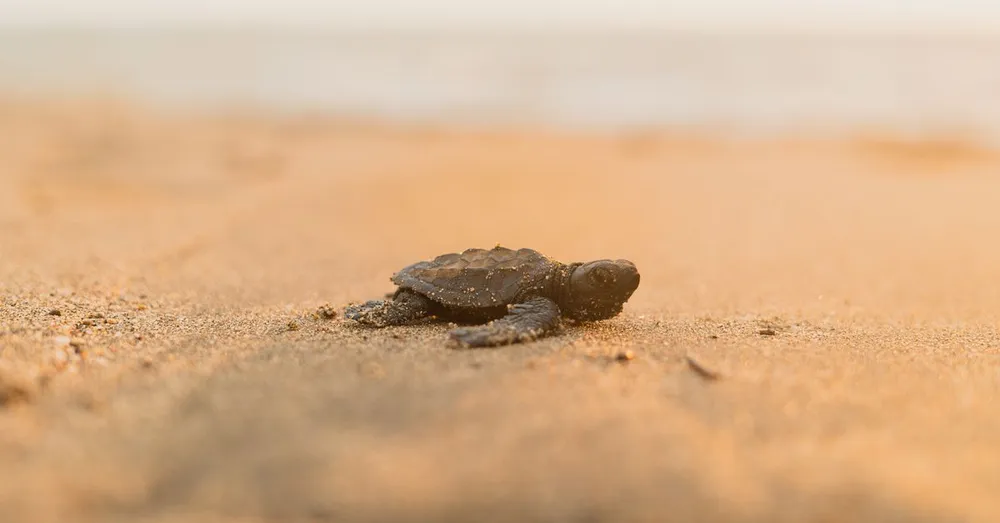
- July: end of leatherback nesting, which overlaps with the first emergences (hatchlings coming out, after an incubation of about 60 to 65 days).
- August to September: hatching and emergence of the newborns making their way to the ocean; green and olive ridley turtles extend the activity.
There is an important nuance to know. French Guiana’s main tourist dry season runs from mid-July to mid-November: it is the best weather window for visiting the territory. Yet the peak of leatherback nesting (May-June) falls during the rainy season. Good news: in July, the two windows overlap. If your number-one goal is to see a leatherback nest, aim for April to June. If you want to try for the double chance of nesting plus first hatchlings just as the climate dries out, early July is, in my view, the ideal compromise.
What time to come
Turtles almost always nest at night, generally between 8 p.m. and 2 a.m. (sometimes until dawn), often around high tide. The tide matters a great deal: nesting visits are more numerous at high or rising tide, because the females take advantage of the water level to approach the upper beach. Check the day’s tide times (posted locally and available online), arrive at dusk (around 6.30-7 p.m. at these latitudes) and allow one to two hours on site to maximise your chances.
The good spots on Hattes Beach
Hattes Beach stretches over several kilometres. Not all sectors are equal depending on the period and on sand erosion, which changes from one year to the next.
- Pointe Isère and the eastern sector of the beach: areas historically very frequented by leatherbacks, often the densest at peak season.
- In front of the village of Yalimapo: the easiest access, handy for a first observation on foot.
- Hattes Beach on the Maroni mouth side: a wilder atmosphere, best approached with a knowledgeable companion.
My advice: do not set off blind. First stop by the Maison de la Réserve naturelle de l’Amana or with a local kali’na guide. They know where the nesting visits concentrate during the week of your stay and will keep you from trampling nests.
The golden rules for watching without disturbing
This is the heart of the matter. A nesting turtle is extremely sensitive to disturbance, especially during the phase when she digs her nest and chooses her spot: a disturbed female may turn back without nesting. The hatchlings, for their part, orient themselves towards the brightest horizon, and the slightest lamp disorients them. Here are the rules I systematically repeat, which match the reserve’s guidelines:
- No white light. Headlamps, phones, screens: all of it disorients the turtles and the hatchlings. Use only a lamp with a red filter, and as little as possible.
- No flash, ever. Flash photography can make a female give up nesting, neither on the adult nor on the babies.
- Stay behind the turtle, never in front of her head, and keep your distance while she is looking for her spot.
- Approach only during nesting. Once the female is laying, she enters a kind of trance and tolerates a discreet presence better. Before that, stay back.
- Silence and calm: no shouting, no music, no abrupt movements.
- Do not touch the turtle or the eggs, do not walk on the upper beach where the nests are buried, never climb on them.
- Follow a guide from the reserve or a local association: it is the best way to approach at the right moment and the right place.
- Respect the kali’na site: you are on Amerindian land. You do not camp just anywhere, you leave no litter, and you ask before photographing people.
Guided tours and associations
Several organisations supervise the observation, notably the Kwata association and the local guides of Awala. Some of the reserve’s activities are free or modestly priced; guided outings generally cost between 15 and 30 € per person, sometimes less for children. They greatly increase your chances of seeing a complete nesting while ensuring respectful behaviour. The Maison de la Réserve de l’Amana, on site, will give you up-to-date information on the best nights.