
Hostel Toucan — Apartments & Hotels
Menu

Settling in

Cost of living in Martinique

Published on July 30, 2026 · by Ismael Samuel

Cost of living in Martinique

Planning a job transfer, a career change or simply a fresh start in Martinique? The budget question comes up fast, and for good reason: living on the island often costs more than in mainland France on several fronts, especially food and energy, while other expenses (no heating, an outdoor lifestyle) get lighter. This article gathers concrete benchmarks to help you estimate your monthly budget and avoid nasty surprises. All amounts are indicative: they vary by town, season, personal habits and market conditions. They are there to frame your project, not to replace an actual quote or lease.

Why living costs more in Martinique

Martinique is a French overseas department located more than 6,700 km from mainland France. That distance shapes prices: most everyday consumer goods are shipped in by sea, which adds freight, octroi de mer (a local tax specific to the overseas departments) and distribution margins. As a result, price gaps with the mainland on mass-market food products are real and sometimes significant, particularly on national brands and processed goods.

Conversely, some line items work in your favour:

  • No heating to budget for, all year round: the tropical climate removes a major winter expense.
  • Affordable local produce at the markets: fruit, local vegetables and fresh fish often cost less than an imported equivalent.
  • Social life and leisure outdoors: beaches, hikes, markets and boat trips remain low-cost activities.

Understanding this logic helps you make trade-offs: favour local produce and markets, limit imported brands, and plan ahead for the unavoidable items such as electricity and fuel.

Couple etablissant son budget mensuel du foyer avec calculatrice, factures et ordinateur portable
Etablir son budget mensuel : loyer, courses, energie et transports pesent lourd dans le cout de la vie en Martinique. — © Photo Mikhail Nilov via Pexels

Housing: rent by area

Housing is the biggest expense. Rent levels depend heavily on location, the condition of the property, whether there is a sea view or outdoor space, and how close amenities are.

The main market areas

  • Fort-de-France and its outskirts (Schoelcher, Le Lamentin): this is the island’s employment and administrative hub. Schoelcher, with its university campus and residential neighbourhoods, remains in high demand. Le Lamentin is home to the airport, the business park and plenty of shops.
  • The tourist South (Les Trois-Îlets, Sainte-Anne, Le Diamant, Sainte-Luce): sought-after areas for their beaches and quality of life, with rental pressure heightened by short-term holiday lets. Rents here are often among the highest on the island.
  • The Caribbean and Atlantic North (Saint-Pierre, Le Carbet, La Trinité, Le Robert, Le François): a more authentic setting, generally more affordable, but far from the main employment areas, which pushes up your transport budget.

Rent benchmarks (indicative)

As a rough guide, and depending on the season and the condition of the property:

  • Studio or one-bedroom: low to mid range depending on the area, higher in the tourist South.
  • Family three-room flat: clearly more expensive near Fort-de-France and on the southern coast than in the rural North.
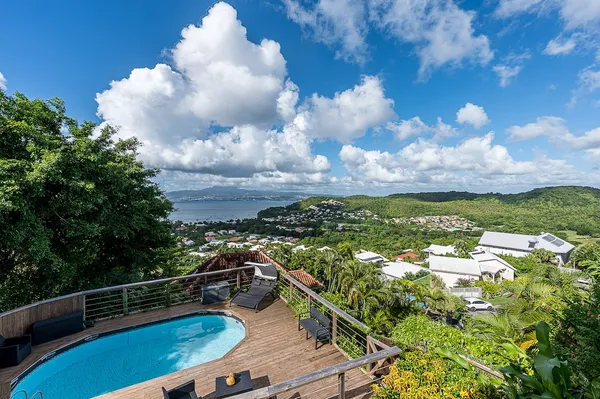
  • House with outdoor space: highly variable, with sea views and pools driving prices up.

Also factor in charges (water, upkeep of shared areas in a co-ownership) and expect quality properties to go fast. One important practical point: many landlords ask for a security deposit and solid supporting documents. Arriving with a complete application (payslips, employment contract, a guarantor if possible) makes all the difference.

Energy and water: line items not to underestimate

Electricity is a sensitive expense in Martinique. Even without heating, air conditioning can send your bill soaring if you equip several rooms and use it intensively. Many households strike a balance by air-conditioning mainly the bedrooms at night and relying on natural ventilation and ceiling fans during the day.

A few habits that weigh on the monthly budget:

  • Choose a well-ventilated, well-oriented home to limit your reliance on AC.
  • Go for a solar water heater whenever possible: the sunshine makes domestic hot water very cheap.
  • Keep an eye on humidity: it wears out electronics and clothing, a real indirect cost.

Water is another item to build in, with rates that vary by town and by period. During the dry season (le carême, roughly January to June), some areas may face occasional restrictions.

Food and groceries: where and how to shop

Food is where the price gap is felt most in everyday life. To keep this item under control:

  • Buy your fruit and vegetables at the market: Fort-de-France, Le Marin, Sainte-Anne, La Trinité and many other towns have lively markets where local produce is fresh and affordable.
  • Buy fish at the water’s edge: landing points and fish markets offer excellent value for money.
  • Compare supermarkets: the chains in the Lamentin area and the shopping centres compete in a way that works to your advantage.
  • Cut back on imported brands and processed products, the ones hit hardest by the extra costs.

Partly adopting Creole cooking based on local produce (yams, dasheen, chayote, plantains, local fish) is as much a pleasure as a money-saving strategy. Conversely, trying to replicate your mainland habits exactly, with specific brands, will push the bill up.

Mains comptant de l'argent liquide avec une calculatrice, un agenda et des tickets de caisse
Calculer ses depenses au quotidien : le pouvoir d'achat en Martinique se joue sur les courses et les factures. — © Photo Kaboompics.com via Pexels

Transport: a car is close to essential

Public transport exists but remains limited outside the Fort-de-France conurbation. For most newcomers a car is essential, especially if you live in the North or South and work in the centre.

Items to build in:

  • Fuel: prices are regulated in the overseas departments and fluctuate, but your budget depends above all on your commute.
  • Insurance and servicing: plan for these as you would on the mainland, bearing in mind a salty climate that speeds up corrosion.
  • Buying the vehicle: the second-hand market is active; cars often hold their value well, which cuts both ways.

Rush-hour traffic around Fort-de-France and Le Lamentin is a real thing: expect journey times that can be long, which will influence which town you choose to settle in.

Estimating your monthly budget: method and example

Rather than a single misleading figure, think in terms of line items. Here is an indicative framework to adapt:

  • Housing: rent + charges + a security deposit to set aside on arrival.
  • Energy and water: electricity (including AC), water, possibly gas.
  • Food: balanced between the local market (economical) and the supermarket (imported).
  • Transport: fuel, insurance, servicing, and possibly a car loan or purchase.
  • Telecoms: internet and mobile, with local deals worth comparing.
  • Health, leisure, contingencies: top-up health cover, outings, a rainy-day fund.

A couple settling in would be wise to increase the budget for the first few months: a double security deposit (housing plus possibly a vehicle), kitting out the home, and the time it takes to find your local bargains. Setting aside a comfortable relocation fund spares you the stress of those first weeks.

Budget checklist before you leave

  • Estimate your target rent for the town you have in mind (North, Centre, South)
  • Set aside the security deposit(s) (housing, vehicle)
  • Budget for a vehicle (purchase, or rental while you get set up)
  • Cost out furnishing the home (appliances, furniture if unfurnished)
  • Compare local internet and mobile deals
  • Build up relocation savings covering several months
  • Put together a complete rental application (income, contract, guarantor)
  • Arrange temporary accommodation for the first few weeks

Preparing your arrival from mainland France

The most common trap is trying to sort everything out remotely: signing a lease without having seen the neighbourhood, underestimating journey times, or arriving with no housing solution. The most stress-free strategy is to arrive in temporary accommodation first, giving you time to visit in person, understand the micro-markets town by town and make an informed choice.

This transition phase lets you:

  • Visit properties on site, avoid misleading listings and negotiate from a position of strength.
  • Test your real commute at rush hour.
  • Scope out the markets, shops and local services that will shape your daily life.

That is exactly what a stay in one of our properties is for: drop your bags with no long commitment, take your time, then decide. And for owners who want to hand over the management of their property during or after settling in, our property management service supports the rental process by the book.

Frequently asked questions

Is life really more expensive than in mainland France?

On imported food and energy, yes, the gap is real. But the climate removes heating costs, local markets are affordable and outdoor leisure is cheap. Your overall budget depends a great deal on your consumption habits.

Do you absolutely need a car in Martinique?

In most cases, yes, especially outside the Fort-de-France conurbation where public transport is limited. Living without a car is feasible in the urban centre, but restrictive as soon as your home or workplace moves away from it.

Which town is the cheapest for housing?

Broadly speaking, the North (Caribbean and Atlantic coasts) and the interior are more affordable than the tourist South and the areas near Fort-de-France. The trade-off is a higher transport budget if you work in the centre. These trends are indicative and shift with the market.

How much should you plan for the first few months?

Beyond your day-to-day budget, set aside security deposits, the cost of furnishing your home and a contingency fund covering several months. A comfortable relocation fund is the key to a smooth start.

Can you find housing remotely before arriving?

It is possible but risky: nothing replaces a viewing. The safest option is to arrive in temporary accommodation, then search on the ground once you understand the neighbourhoods and the commutes.

In summary and next steps

Settling in Martinique is a wonderful project, provided you build a realistic budget line by line and keep some slack for the first few months. The best starting point is often temporary accommodation, giving you time to visit, compare and choose without rushing.

Ready to plan a smooth arrival? Book temporary accommodation among our properties for your first weeks on the island, browse the blog to dig deeper into your move, and feel free to contact us: we will help you organise your transition to Martinique.

🧭 Which stay suits you?

3 questions, 20 seconds.

Also read