
You are preparing a transfer, a contract or a permanent move to French Guiana from mainland France, and one question keeps coming back: how much does life there actually cost? The honest answer is “it depends”, because a single person’s budget in Cayenne has nothing in common with that of a family settled in Kourou or Saint-Laurent-du-Maroni. French Guiana is a French department where the currency, social security and labour law are the same as in mainland France, but where remoteness, the need to import a large share of goods and the equatorial climate shape a very distinctive set of expenses.
The aim of this article is to give you figures for guidance only — ranges that vary with the season, the town, your habits and shipping rates — so you can build your own monthly budget. None of the numbers below should be taken as a fixed truth: treat them as orders of magnitude to verify once you arrive. If you need somewhere to stay while you look for permanent housing, take a look at our accommodation in French Guiana and feel free to contact us to plan your arrival.
Why living costs are higher in French Guiana
Before going into each spending category, it helps to understand why the cost of living is generally perceived as higher than in mainland France, particularly for food and manufactured goods.
- Distance and imports. A large share of everyday consumer goods arrives by ship or plane, which pushes prices up through freight and logistics costs.
- A small market. Competition between retail chains is more limited than in mainland France, leaving less downward pressure on certain prices.
- The equatorial climate. Year-round heat and humidity often mean air conditioning, a line item that weighs heavily on the electricity bill.
- Specific local realities. The octroi de mer, a tax specific to the French overseas territories, applies to many imported goods and affects retail prices.
On the other hand, some measures do exist: civil servants posted there may receive a salary uplift (the overseas pay supplement), and “bouclier qualité-prix” schemes cap the price of a basket of reference items in supermarkets. It is up to you to check your exact situation depending on your status.

The grocery budget: food and everyday products
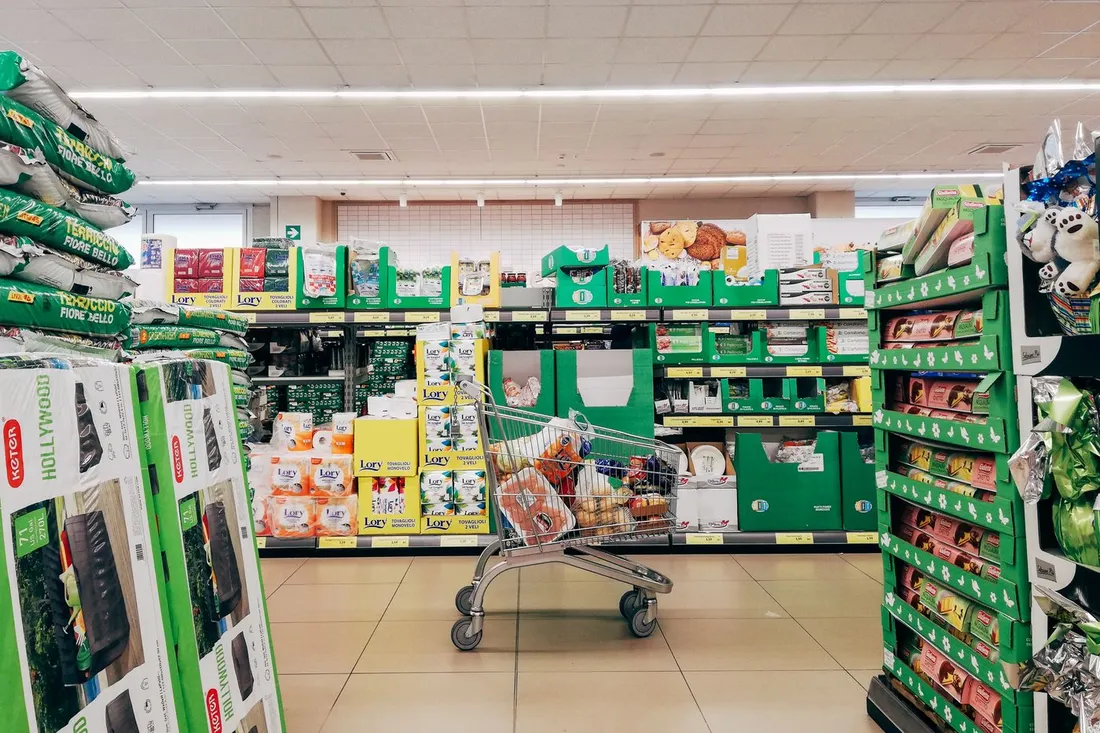
This is often the first shock on arrival. On imported products — cereals, dairy from mainland France, branded soft drinks, toiletries, frozen food — the price tags can be surprising. Conversely, buying local rebalances the basket considerably.
Where to shop
- Supermarkets (in Cayenne, Matoury, Rémire-Montjoly, Kourou, Saint-Laurent) for imported products and the bulk of the basket.
- Markets — the Cayenne market, the one in Saint-Georges, or the Hmong markets in Cacao and Javouhey — for fruit, vegetables, herbs and fresh produce at often far gentler prices.
- Neighbourhood shops and convenience stores, handy but generally more expensive.
- Local producers and direct sales, invaluable for local vegetables, fish and sometimes meat.
How to lighten the basket
The winning strategy is to shift part of your diet towards local and seasonal food. Cassava, dachine (taro), sweet potato, bananas, pineapple, local citrus, river or sea fish: these products are often more affordable and far fresher than their imported equivalents. Conversely, mainland cheeses, fine charcuterie and imported branded products drive the bill up.
As an indication, a monthly food budget may fall:
- for a single person cooking at home and buying local, within a moderate range but higher than in mainland France;
- for a couple, within a noticeably higher range;
- for a family with children, within a range that can clearly exceed what you were used to in mainland France, especially if you stick to 100% “imported products” habits.
These orders of magnitude vary considerably depending on the season, the time of year (prices of some fresh products move with the rains) and your own trade-offs.
Housing: rents and charges by town
Housing is the other major expense. Rent levels depend very heavily on the town, the neighbourhood and the condition of the property.
The main areas
- Cayenne and its urban area (Rémire-Montjoly, Matoury) concentrate jobs, services and much of the rental demand; rents there are generally the highest in the department. The residential neighbourhoods of Montjoly and Montabo are sought after.
- Kourou, shaped by the activity of the Guiana Space Centre, has its own rental market, dependent on activity cycles.
- Saint-Laurent-du-Maroni, in the west, often offers more affordable rent levels, but with a different supply and different services.
- More rural or remote towns offer lower rents, at the cost of being far from services.
What to plan for
On top of the rent come charges that can weigh heavily: water, electricity (especially with air conditioning), and sometimes building service charges. Also budget for the security deposit and bear in mind how hard it often is to view a property from a distance before signing. That is precisely why many newcomers opt for a temporary solution while they search calmly on the spot: discover our accommodation, designed for a smooth arrival.
Energy, water and connectivity: the charges that climb
Electricity
This is the item most specific to the climate. Air conditioning, if you rely on it daily, can account for a significant share of the bill, especially in a poorly insulated home. A few simple levers:
- favour a well-ventilated home with ceiling fans rather than “all air-con”;
- close shutters and curtains during the hottest hours;
- service the air conditioners to keep them efficient;
- compare properties on their orientation and insulation before signing.
Water
The water bill depends on the town and your consumption. In a climate where you shower often and sometimes water the garden, it deserves to be planned for.
Internet and phone
Fibre has been rolled out in several towns, but coverage remains uneven depending on the neighbourhood and in more remote areas. Check whether the address is eligible before committing, as it may determine how comfortably you can work from home.