Many owners in French Guiana discover LMNP social contributions in French Guiana the day the CGSS sends them a letter. Across Cayenne, Rémire-Montjoly and Kourou, short-term rentals have boomed thanks to the rotations at the Space Centre: studios let for €60 to €90 a night, sometimes more than €1,500 in monthly revenue during the dry season. Yet, as soon as your annual short-term furnished rental revenue exceeds €23,000, you become a contributor in the eyes of Social Security. Here is the complete guide, tailored to the administrative realities of the territory, written by a team that manages furnished rentals on the ground every day.
The €23,000 threshold: the red line for furnished rental hosts
This is THE figure to remember. The €23,000 threshold in annual revenue (rents, charges included, not the profit) triggers the obligation to register with Social Security for short-term furnished rentals, the kind offered on Airbnb, Booking or directly.
In practical terms, three possible situations:
- Revenue below €23,000 per year: no social affiliation. Your rental income remains income from assets, subject to social levies of 17.2% on top of income tax. A one-bedroom flat in Cayenne let at €70/night with 60% occupancy generates around €15,300: you stay below the threshold.
- Revenue above €23,000 in short-term lets: registration is mandatory, even if you remain a non-professional furnished rental host (LMNP) for tax purposes. You then choose between the general scheme, micro-entrepreneur status or the SSI.
- Revenue above €23,000 AND above the other earned income of the tax household: you switch to professional furnished rental host (LMP) status, with affiliation to the Social Security scheme for the self-employed.
Beware of the classic trap in French Guiana: two studios in Kourou let to the Ariane 6 launch teams during firing campaigns can exceed the threshold before you anticipate it. The calculation covers all short-term furnished rentals in the tax household, not property by property.
Long-term rentals: different rules
If you let furnished on a yearly basis (12-month lease, very common for teachers and military personnel posted to Matoury or Saint-Laurent-du-Maroni), you remain outside professional contributions as long as you are not an LMP: only the 17.2% social levies apply. A serious argument for mixing short- and long-term lets.
URSSAF in French Guiana: it’s the CGSS that handles your file
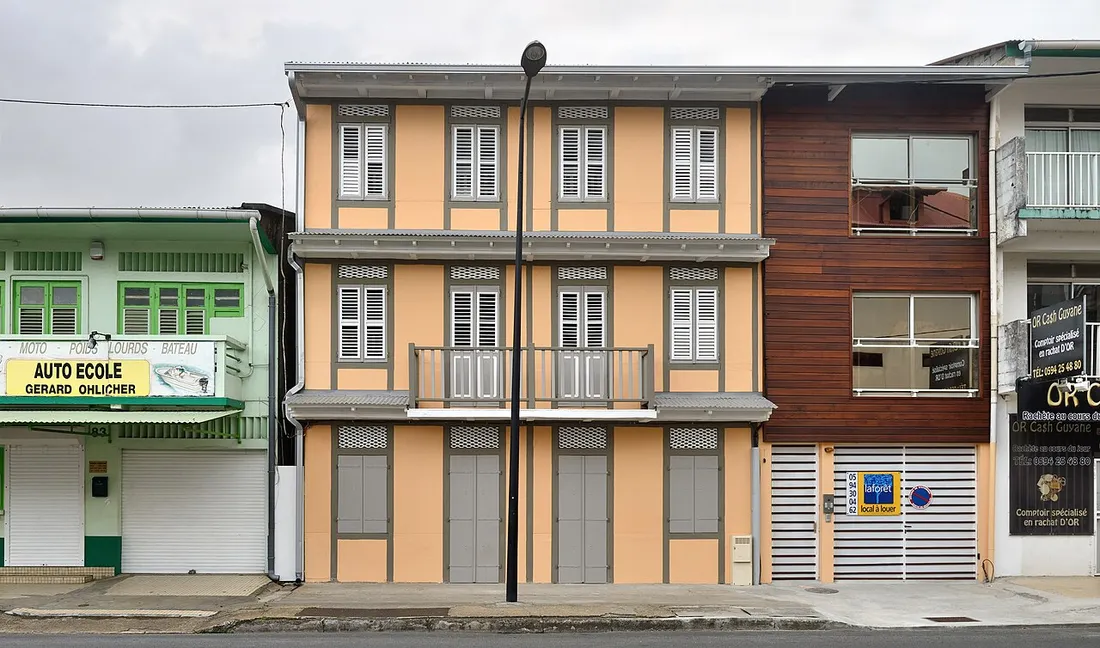
An essential feature of the furnished rental URSSAF in the DOM: in French Guiana, there is no standalone URSSAF. It is the Caisse Générale de Sécurité Sociale (CGSS) de Guyane, based at Espace Turenne Radamonthe, route de Raban in Cayenne, that carries out URSSAF’s collection duties for the entire territory, from Macouria to Saint-Laurent-du-Maroni.
What this changes in practice:
- A single point of contact: health insurance, pensions and contribution collection all go through the same body, which simplifies the process but sometimes lengthens processing times (allow 4 to 8 weeks for registration, versus 2 to 3 in mainland France).
- Online procedures remain national: registration is done on autoentrepreneur.urssaf.fr or formalites.entreprises.gouv.fr, with automatic linkage to CGSS Guyane via your address.
- The time difference works against you: with -5h in winter and -6h in summer compared to Paris, the national phone lines close at 12pm or 1pm Cayenne time. Favour in-person appointments at the CGSS or secure messaging.
A field tip: keep every acknowledgement of receipt; a dated proof will spare you unjustified late-payment surcharges.
SSI host in French Guiana: which scheme to choose above the threshold?
Once the threshold is crossed, three options are open to you. The choice deserves a proper simulation, as the gap can reach several thousand euros a year.
Option 1: micro-entrepreneur status (the simplest)
You declare your revenue each month or quarter and pay a flat percentage:
- About 21.2% of revenue for an unclassified tourist furnished rental;
- About 6% of revenue for a classified tourist furnished rental (prefectural classification of 1 to 5 stars), a massive advantage that alone justifies the classification process, billed at around €150 to €250 by an accredited body.
A specific advantage in the DROM: micro-entrepreneurs in French Guiana benefit from a reduced scale (LODEOM exemption), with rates cut by roughly a third at cruising speed and even lower during the first two years of activity. On €30,000 of revenue from a classified rental, the difference with mainland France runs into hundreds of euros a year.
Option 2: the general scheme (treated as an employee)
Possible as long as your revenue stays below about €85,000. You contribute only on your revenue reduced by a 60% deduction (87% for a classified rental). Worthwhile if your activity is highly seasonal, calibrated for example to the dry season from July to late November, since you pay almost nothing in the off months.
Option 3: SSI as a sole proprietorship under the actual regime
The SSI host in French Guiana under the actual regime calculates contributions on your profit (revenue minus charges and depreciation), at an overall rate of about 35 to 40%. Two points of caution:
- A minimum contribution of about €1,200 per year applies even in case of a loss, frequent in the early years with depreciation of the property;
- In return, you validate pension quarters and benefit from daily allowances, something the 17.2% social levies never provide.
This is often the relevant option for multi-property owners in Rémire-Montjoly or Roura who generate a real profit after depreciation.