Hostel Toucan — Apartments & Hotels
Menu

Settling in

School enrolment in the French overseas territories: key dates

Published on July 30, 2026 · by Ismael Samuel

School enrolment in the French overseas territories: key dates

Moving from mainland France to Martinique, Guadeloupe or French Guiana with children raises a question that worries many families: when should you enrol the children in school, and with whom? The good news is that all three territories belong to fully fledged education authorities, with the same curricula, the same qualifications and broadly the same official calendar as mainland France. The less good news is that local processing times, the availability of places and the logistics of a transatlantic move often complicate the theory.

This article takes you step by step through the enrolment windows from primary to secondary school, the people to contact depending on the town you are moving to, and the documents to prepare before you even set down your suitcases. The dates and timeframes given here are indicative: they vary by education authority, by town hall and by school year. Always check with the school or town hall concerned.

Understanding how schooling is organised overseas

Before talking about the calendar, you need to know who decides what. The division of responsibilities is the same as in mainland France, which helps you find your way.

Who handles what

  • The town hall (mairie) handles enrolment in nursery and primary school (premier degré). It issues your enrolment certificate and assigns your child to a school according to the town’s catchment map.
  • The middle school (collège) depends on the departmental council for its buildings, but placement goes through the services of the Direction des services départementaux de l’Éducation nationale (DSDEN) of the education authority.
  • The high school (lycée) falls under the region (single territorial authority in Martinique and French Guiana) for its premises, and under the education authority for placement.
  • Each of the three territories has its own rectorat (education authority headquarters): académie de Martinique, académie de Guadeloupe, académie de Guyane.

A French Guiana particularity

French Guiana is the territory with the most dynamic school demographics in France: the population is young and growing fast, especially along the coast (Cayenne, Matoury, Rémire-Montjoly, Kourou, Saint-Laurent-du-Maroni). In practice, this means places can be tight in some towns and that planning ahead matters even more than in the Antilles. As a rough guide, it is best to start the process several months before the start of term, as early as possible.
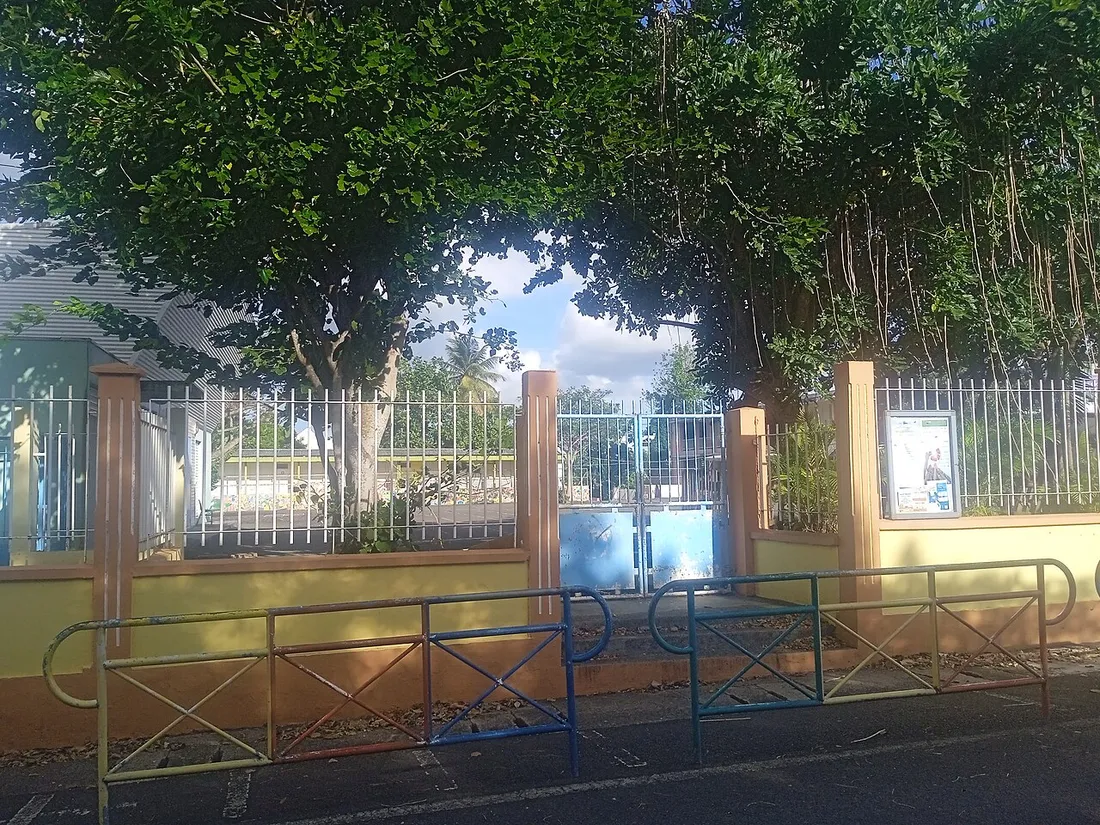
Entrée grillagée de l'école du Bourg de Sainte-Rose en Guadeloupe, avec barrières colorées et panneau d'affichage sous les arbres
Une école publique du Bourg de Sainte-Rose, en Guadeloupe : la scolarisation outre-mer suit le calendrier de l'Éducation nationale, avec ses propres dates d'inscription. — © Enrevseluj (Wikimedia Commons, CC BY-SA 4.0)

The general enrolment calendar

The official calendar follows the mainland one, with the school year generally starting in early September (the exact date is set each year by the ministry). Here are the main windows, as a guide.

Primary level (nursery and primary school)

For a September start, enrolment at the town hall often opens during the spring (March-April-May depending on the town). Ideally you should:

  1. Contact the school services department of your future town hall as soon as your move is confirmed.
  2. Obtain the enrolment certificate issued by the town hall.
  3. Finalise admission directly with the school (an appointment with the head teacher).

If you arrive mid-year (a transfer in January, for example), enrolment is still possible: this is known as mid-year enrolment, handled case by case depending on available places.

Secondary level (collège and lycée)

For middle and high school, placement depends on the education authority’s procedures:

  • Entry into Year 7 (6e) is generally prepared in the spring, in liaison with the child’s previous primary school and the DSDEN.
  • Entry into Year 11 (2de) at high school goes through the education authority’s placement procedure (often online), with windows in the spring.
  • For an arrival outside the calendar (a mid-year transfer), the DSDEN or the rectorat handles placement according to available places.

As a rough guide, allow several weeks of processing between your application and confirmation of placement, especially if you arrive outside the standard period.

Transfers and mid-year arrivals

Many families do not arrive exactly in time for September: a work transfer, a civil service posting, an opportunity seized mid-year. Here is how to proceed.

The process step by step

  • Obtain the certificate of de-registration (or “exeat”) from the previous school in mainland France before leaving. This is the key document for any re-enrolment.
  • Contact the receiving town hall (primary level) or the DSDEN (secondary level) of the territory concerned.
  • Provide the latest school report and, for collège/lycée, the academic records needed for a consistent placement.
  • Allow time: an out-of-period placement can take a while, especially in French Guiana where pressure on places is real.

What can go wrong

The main risk is a lack of places in the catchment school. In that case, the education authority may offer another school, sometimes further from your home. Hence the value of choosing the neighbourhood you settle in with the catchment map in mind, rather than the other way round.

Choosing your town with school in mind

Where you live determines your children’s school, via the catchment map. Here are some concrete pointers by territory.

In Martinique

Families frequently settle around Fort-de-France, Le Lamentin, Schoelcher (close to the university) and Ducos. The south (Le Marin, Sainte-Anne, Le Diamant) is popular for its quality of life but is further from the main employment hubs and from some schools. Bear in mind travel times, sometimes lengthened by rush-hour traffic on the Fort-de-France / Le Lamentin corridor.

In Guadeloupe

The Pointe-à-Pitre / Les Abymes / Le Gosier / Baie-Mahault conurbation concentrates most services and schools. Basse-Terre, the administrative capital, offers a quieter setting. Watch out for the archipelago factor: if you are looking at Marie-Galante, Les Saintes or La Désirade, schooling options there are more limited, especially at high-school level, which may mean boarding school or boat journeys.

In French Guiana

Along the coast, Cayenne, Rémire-Montjoly and Matoury form the heart of the conurbation, with Kourou (around the space centre) and Saint-Laurent-du-Maroni to the west. Demand for places is high there. In inland or riverside communes, provision is more limited. Plan well ahead if you are targeting these areas.


Main entourant au stylo une date sur un calendrier de bureau, posé près d'une tablette
Repérer les dates clés : chaque étape d'inscription scolaire a sa date limite à noter au calendrier. — © Towfiqu barbhuiya (Pexels, Licence Pexels)

Documents to prepare before you leave

The golden rule: put your file together before leaving mainland France, because retrieving a forgotten document from a distance is a chore. Here is a checklist so nothing is left out.

  • Certificate of de-registration (exeat) from the previous school
  • Family record book (livret de famille) or the child’s birth certificate
  • Proof of address in the receiving town (or a temporary accommodation certificate)
  • Up-to-date health record book, with compulsory vaccinations
  • Latest school reports and, where applicable, the latest livret scolaire unique (LSU)
  • Parents’ identity documents
  • School insurance certificate (can be taken out on arrival)
  • Recent passport photos of the child

The sticking point: proof of address

This is often where things get tricky. Many families arrive before signing a definitive lease, taking the time to view properties and choose. Yet enrolment at the town hall requires proof of address. A temporary accommodation certificate or a bill linked to interim housing may do the job in the meantime. Check with the town hall which documents it accepts: flexibility varies from one town to another.

Vaccinations and school health

The vaccination requirements for entering a group setting are the same as in mainland France. One point deserves attention depending on the territory.

  • In French Guiana, yellow fever vaccination is compulsory for anyone residing in the territory (from the required age). This is a specific requirement to factor in well in advance, as the vaccine needs time to become effective.
  • The health record book must be up to date: schools may ask for it at enrolment.
  • Remember to find a local GP quickly, especially if your child is on treatment or has a support plan (PAI, PPS).

Planning your arrival properly: the housing question

The school calendar and the property calendar are closely linked. Many families underestimate how long it takes to find permanent housing overseas, where the rental market can be tight and where it is better to view properties in person before committing.

  1. Arrive a few weeks before the start of term if possible, to view homes and get to know the neighbourhoods.
  2. Stay somewhere temporarily in furnished accommodation while you secure a lease and proof of address.
  3. Choose your permanent neighbourhood taking the catchment map and travel times into account.
  4. Finalise the enrolment once your address is settled.

This approach avoids two common pitfalls: signing a lease remotely without having seen the area, and getting stuck on enrolment for lack of proof of address. Comfortable interim accommodation, where the whole family can unpack, makes all the difference in tackling these steps calmly. That is exactly what we offer among our properties, designed for relocation stays.

If you own a property locally that you are not yet living in, or if you are looking to make a home earn its keep during your transition, take a look at our property management service.

Frequently asked questions

Can you enrol a child in school without permanent housing yet?

Yes, this is common. The town hall asks for proof of address, but a temporary accommodation certificate is often accepted while you wait for a lease. Check with the town concerned, as accepted documents vary. Staying in interim accommodation is precisely a way to obtain provisional proof.

Is the overseas school calendar the same as in mainland France?

The official calendar and holidays follow the national rhythm, with the school year generally starting in early September. Exact holiday dates may differ slightly depending on each territory’s education zone. Check the calendar of the académie de Martinique, de Guadeloupe or de Guyane for the year concerned.

What if I move mid-school-year?

Mid-year enrolment is possible. Obtain the certificate of de-registration from the previous school, then contact the town hall (primary level) or the DSDEN/rectorat (secondary level) of the receiving territory. Placement depends on available places, which can take time, especially in the most sought-after towns.

Are there specific health requirements in French Guiana?

Yes. Yellow fever vaccination is compulsory to reside in French Guiana from the required age, and time is needed before it becomes effective. Plan this vaccination before you leave, in addition to the usual vaccinations required for entering a group setting.

How long should I allow before the start of term to organise everything?

As a guide, aiming for several months’ lead time for enrolment and a few weeks on site before term starts for housing is comfortable. In French Guiana and in the most sought-after conurbations, the earlier the better, as places can be limited.

In short: plan ahead, and sort your housing first

Schooling your children in Martinique, Guadeloupe or French Guiana is nothing insurmountable: same curricula, same qualifications, same broad calendar landmarks as in mainland France. The real difficulties are logistical: availability of places (especially in French Guiana), proof of address, and coordinating the move with the start of term. The key is to prepare the file before you leave and to rely on interim accommodation so you can choose your neighbourhood calmly.

Preparing your move overseas? Book comfortable temporary accommodation for the whole family from our properties and send us your questions: contact us. For more practical guides on settling in the French Antilles and Guiana, browse the blog.

🧭 Which stay suits you?

3 questions, 20 seconds.

Also read