You are preparing a job transfer, a relocation or a long stay in Martinique, Guadeloupe or French Guiana, and you have no intention of leaving your dog or cat behind in mainland France. Good news: travelling to the French overseas departments (DOM) with a pet is perfectly possible, and far simpler than flying to a foreign country, since it counts as a domestic journey within French territory. But there are rules to follow, lead times to plan for (often several weeks, sometimes several months) and a tropical reality to prepare for: heat, humidity and local wildlife. This guide walks through the paperwork, the cabin-or-hold decision, how to prepare the journey and what to expect in the first few days, so your companion arrives without stress.
The information below is provided for guidance only: health rules, airline fares and acceptance conditions change regularly. Always check with your vet and with the airline before booking.
A domestic flight: what changes (and what does not)
Martinique, Guadeloupe and French Guiana are French departments and part of the European Union. A Paris-Fort-de-France, Paris-Pointe-a-Pitre or Paris-Cayenne flight is therefore a domestic flight in regulatory terms: there is no international border crossing, no quarantine on arrival and no import permit to apply for as there would be for a third country.
In practical terms, this means you do not need:
- an import permit application,
- quarantine on arrival,
- a rabies antibody titration test (the serological test required for certain foreign destinations).
That said, basic French health regulations still apply, and airlines impose their own rules, often stricter than the legal minimum. It is above all the airline that will shape your journey: which breeds are accepted or not, maximum weight in the cabin, availability of a climate-controlled hold, restrictions linked to heat.
One special case: transiting through a third country
If your ticket routes you through a country outside France or outside the EU (a long layover, for instance), the situation can change and entry/exit formalities may be added. Wherever possible, favour a direct flight or a connection within French territory.
The health paperwork to put together
Even for a domestic journey, your pet must be fully compliant. Here are the documents and procedures to plan for.
Mandatory identification
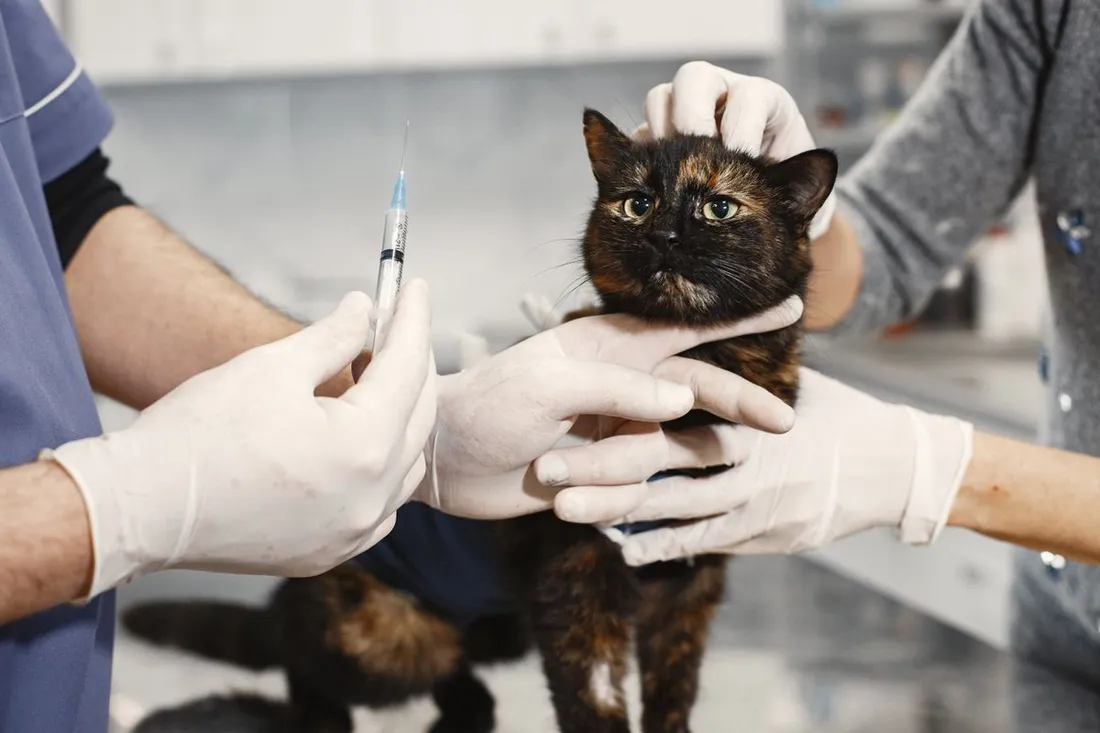
Your dog or cat must be identified with a microchip (transponder). This is the foundation: without identification, the animal can neither travel nor be registered. If your pet still carries a tattoo (the old system), the tattoo must be legible and predate the day microchipping became mandatory; in practice, the microchip is now the standard and some airlines recognise nothing else.
Rabies vaccination
This is the point to plan for earliest. Rabies vaccination is required to travel to the DOM. It only becomes valid after a primary vaccination waiting period (as a guide, allow several weeks between the injection and effective validity) and the animal must be identified before being vaccinated. A pet that is too young, or vaccinated too late, will not be allowed to fly: do not book your move without agreeing this timeline with your vet.
European pet passport and good health
The European pet passport, issued by a vet, brings together identification, vaccinations and follow-up records. Also plan for a recent veterinary examination certifying that the animal is in good health and fit to travel. Some airlines require a veterinary health certificate dated just a few days before departure.
Documents and procedures checklist
- Microchip fitted and working (identification verified)
- Rabies vaccination up to date and valid on the date of the flight
- European pet passport
- Recent veterinary health certificate (depending on airline requirements)
- Internal and external parasite treatments up to date
- Pet booking confirmed in writing by the airline
- Approved travel crate sized to the animal
Cabin or hold: choosing the right option for your pet
The mode of transport depends mainly on your pet’s weight (crate included) and on the airline’s rules.
In the cabin
Small animals - as a guide, a dog or cat of up to 6 to 8 kg including the crate, depending on the airline - can travel in the cabin, in a bag or soft carrier placed under the seat in front of you. This is the most reassuring option: your companion stays with you, calm and at a controlled temperature. The number of animals allowed in the cabin is capped per flight, hence the importance of booking early.
In the hold
Above the weight allowed in the cabin, the animal travels in the fitted hold, in an approved rigid crate (IATA type). On routes to the French West Indies and Guiana, the hold of long-haul wide-body aircraft is pressurised and temperature-controlled, but the experience remains more stressful for the animal. Get it used to the crate several weeks in advance.
Restricted-category dogs and short-nosed breeds
Two points to watch:
- Category dogs (categories 1 and 2) are subject to specific rules and may be refused by some airlines. Check the details carefully.
- Brachycephalic breeds (French bulldog, pug, boxer, Persian cat and so on), with their flattened muzzles, cope badly with heat and respiratory stress. Many airlines refuse these breeds in the hold, especially in hot weather. For a move overseas, where the heat is constant, this point is decisive.
Planning for heat and a long-haul flight
A flight to Fort-de-France, Pointe-a-Pitre or Cayenne takes, as a guide, between 8 and 9 hours from Paris, on top of which come check-in, waiting time and ground transfers. For an animal, that is a long day.
A few pointers to limit stress:
- Choose the season and the departure time: avoid flying during a mainland heatwave if you can; an early morning or evening departure limits exposure to heat on the tarmac.
- Do not feed your pet right before departure: a light meal a few hours before the flight, not immediately before, reduces the risk of discomfort. Keep water available.
- Do not sedate without veterinary advice: tranquillisers are often discouraged at altitude because they disrupt cardiac and respiratory regulation. Ask your vet for advice.
- Get the crate familiar: feed the animal and let it sleep in its crate for several weeks beforehand, so it becomes a reassuring space.
- A suitable crate: the animal must be able to stand up, turn around and lie down. Attach a water bowl and slip in a cloth carrying your scent.
On arrival, the hot, humid air (often 27 to 32 degrees as a guide, with high humidity) is a shock for an animal coming from mainland France. Plan for fresh water immediately and a shaded spot.