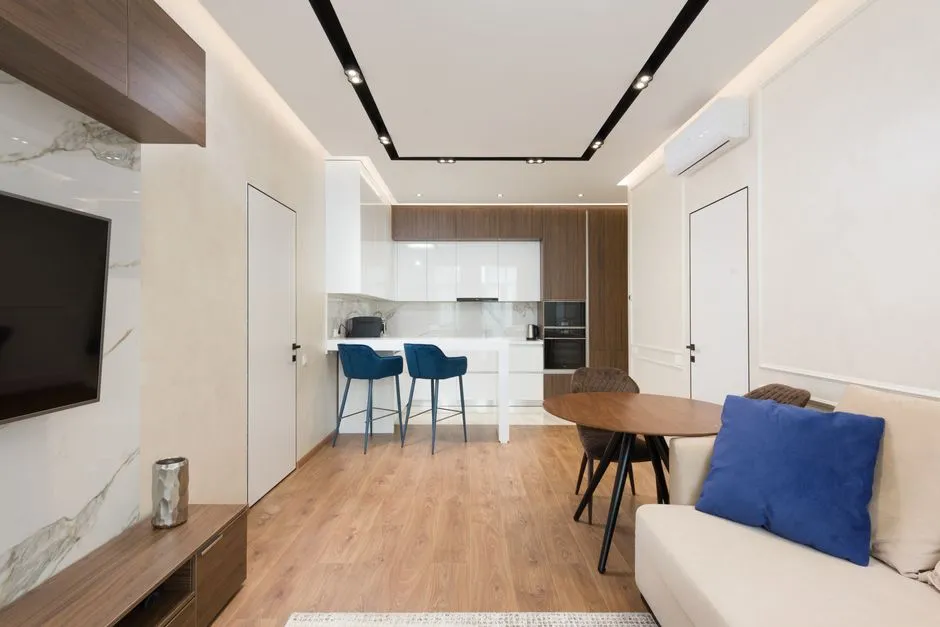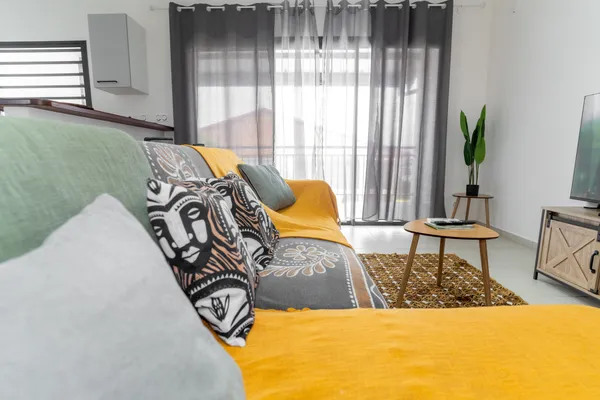

Sending a team on assignment to French Guiana raises a concrete and often underestimated question: where do you house staff with different profiles, over several weeks, without blowing the budget or turning every expense claim into a headache? When the team is mixed — men and women, managers and technicians, employees and contractors, sometimes from different companies brought together on the same site — a hotel quickly shows its limits: rooms billed individually, no kitchen, little privacy, and a bill that climbs as soon as the stay runs beyond a few nights. A private furnished apartment, managed under the para-hotel model, offers a more flexible answer: everyone has their own space, the company receives a single compliant invoice, payment is made by bank transfer, and VAT is recoverable under the usual conditions. This article sets out, from the point of view of an HR manager, an office manager or a project lead, how to organise this accommodation in French Guiana, which neighbourhoods around Cayenne to favour, and which supporting documents to insist on so that accounting signs off without debate.
Why a private apartment rather than a hotel for a team
A hotel still makes sense for a night or two. As soon as the assignment stretches out — installing equipment, an audit, a construction site, seasonal cover, long training — the apartment model changes the equation on several fronts.
- Controlled cost over time: the nightly price of a furnished rental falls mechanically on long stays (weekly or monthly rates), whereas a hotel charges the same price every night.
- Fitted kitchen: the team cooks on site, which sharply reduces the catering budget and suits special diets or shift patterns.
- Separate spaces: several bedrooms, sometimes several apartments in the same residence, make it possible to respect everyone’s privacy.
- Team life: a shared living room makes evening coordination meetings easy, without having to use a public space.
- A single invoice: instead of collecting a pile of individual receipts, the company receives one document in the right format.
For a mixed team, that last point about privacy is often decisive. A residence with several apartments, or a large property with genuinely independent bedrooms (with locks and separate bathrooms where possible), avoids uncomfortable situations and respects the employer’s obligations regarding accommodation conditions.
What the para-hotel model changes in practice
Para-hotellerie means a furnished rental managed with hotel-like services: linen provided, cleaning, welcome on arrival, quick response if something goes wrong. For a company, the appeal is not only comfort: it is the ability to issue a professional invoice in the company’s name, with VAT where the para-hotel services justify it, and to handle payment by bank transfer rather than on a personal card to be reimbursed later.
Cayenne and its surroundings: where to house a team
French Guiana is vast and distances are deceptive. The choice of neighbourhood depends on where the assignment takes place. Here are the useful reference points around the territory’s economic hub.
Central Cayenne
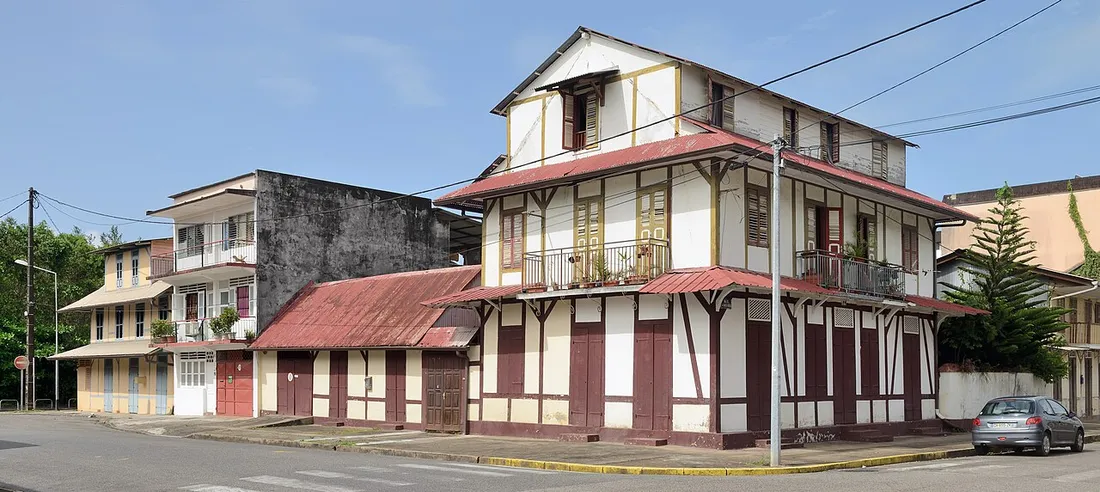
The city centre (the Centre, Place des Palmistes and Village Chinois districts) suits administrative assignments, meetings at the prefecture or in public institutions, and anyone who wants to be within walking distance of shops and restaurants. The Montabo district, residential and close to the coast, is valued for its quiet and its proximity to the university and certain head offices. Cabassou and Mont-Lucas offer more spacious properties, slightly away from the bustle.
The outer ring: Rémire-Montjoly and Matoury
Rémire-Montjoly, on the seafront, is sought after for its pleasant setting, its beaches (Montjoly, Montravel) and its recent residences; it is a good compromise for a team staying several weeks. Matoury, close to Félix Éboué airport, is strategic for assignments involving frequent air rotations or a logistics base near the business zone.
Kourou and the west
If the assignment concerns the space sector, Kourou (about an hour’s drive from Cayenne) is the obvious choice. For western French Guiana (Saint-Laurent-du-Maroni), the distances are real — several hours by road — and accommodation must be planned as close as possible to the site. These travel times are indicative and vary with traffic on the RN1 and road conditions.
Invoicing in the company’s name: the heart of the matter
This is the point that separates professional accommodation from a consumer booking. A standard booking on a mainstream platform often issues a receipt in the traveller’s name, with no usable VAT breakdown and no company details. For a company’s accounts department, that is a problem.
What a compliant invoice must contain
An accommodation invoice acceptable to an accounts department includes at minimum:
- The registered name and address of the client company.
- The provider’s SIREN/SIRET number and, where applicable, its intra-EU VAT number.
- The issue date and a unique, sequential invoice number.
- The description of the service (furnished accommodation, period, address of the property, number of people).
- The amount excluding VAT, the VAT rate and amount, the total including VAT.
- The payment terms (bank transfer) and the provider’s bank details.
On receipt, check that the billed period matches the stay exactly and that the wording clearly refers to an accommodation service, which makes it easier to allocate in the accounts.
VAT: what you need to know
In France, VAT on para-hotel accommodation services is in principle recoverable by the company, unlike certain conventional housing expenses that are subject to restrictions. The applicable rate and the recoverability depend on the exact nature of the services and on the provider’s situation. As French Guiana is an overseas department, the local VAT regime has particularities compared with mainland France. These points must be validated case by case: ask the provider for an invoice that clearly breaks down VAT, and have the treatment confirmed by your accountant. Never assume recovery is automatic without that check.
Expense claims and payment: smoothing the process
A manager’s objective is simple: that the accommodation expense flows through cleanly, without a heavy personal advance and without a missing receipt.
Favour bank transfer
Payment by bank transfer from the company account removes the need for the employee to advance cash and be reimbursed later. It also leaves a clear banking trail that can be matched to the invoice. For a long stay, a deposit at booking followed by a balance (or monthly payments) is a common arrangement; ask for the payment schedule to be set out in writing.
Professional accommodation file checklist
- Written quote stating the period, the number of people and the amount excluding and including VAT.
- Confirmation of invoicing in the company’s name (full details provided in advance).
- Payment terms by bank transfer and payment schedule agreed.
- Invoice received with a detailed VAT breakdown and a sequential number.
- Exact address of the properties and on-site contacts for arrival.
- Inventory and check-in condition report (useful for the deposit and the end of the assignment).
- Cancellation and amendment terms known in advance.
Anticipate the deposit
A security deposit is standard. For a team, clarify from the outset the amount, the method of holding it (card pre-authorisation, dedicated transfer) and the conditions for its return, in order to avoid any friction at the end of the assignment. A documented check-in condition report protects both parties.