
Hostel Toucan — Apartments & Hotels
Menu

Business stays

Group corporate bookings in French Guiana: how it works

Published on July 30, 2026 · by Ismael Samuel

Group corporate bookings in French Guiana: how it works

Housing a team of several people in French Guiana, for a few nights or several weeks, is nothing like booking a holiday. A space mission in Kourou, a construction project along the road to Cayenne, an audit in Saint-Laurent-du-Maroni or a training course in Rémire-Montjoly: as soon as several employees, a company budget and an accounting department are involved, the constraints change. You need an invoice in the company’s name, a valid supporting document for the expense claim, payment by bank transfer rather than on an employee’s personal card, and often a clear view of recoverable VAT.

That is exactly what para-hotel accommodation is designed for — halfway between a classic holiday rental and a hotel. You house your teams in a fully equipped apartment or villa, with the comfort and independence of a complete home (kitchen, laundry room, several bedrooms), but within the administrative framework of a genuine service provider: contract, professional invoice, associated services. This article explains in practical terms how a group corporate booking works in French Guiana, the accounting and tax points to watch, and how our concierge service organises this type of stay.

What we mean by a group corporate booking

A group corporate booking is a stay organised and paid for by a company (or a public body, an association, a training organisation) to house several people, or a single person for an extended period, in a professional context. Several scenarios come up again and again in French Guiana:

  • A project team sent on assignment for a few days to a few weeks (engineering, telecoms, energy, space industry).
  • Workers on a construction site rotating over several months.
  • Consultants, auditors or trainers travelling for a one-off assignment.
  • An employee on a long assignment, while waiting for permanent housing or a transfer.
  • Civil servants travelling on official business.

What they have in common: it is not a private individual booking for themselves, but a legal entity committing professional expenditure. That triggers specific requirements in terms of supporting documents, payment methods and budget tracking.

Para-hotel or holiday rental: the difference that matters

A “pure” holiday rental (the classic furnished tourist property) often makes life difficult for companies: limited invoicing, payment by personal card, VAT not always applicable, no services. Para-hotel accommodation is a better fit for professional needs because it adds hotel-style services (housekeeping, linen supply, welcome on arrival, sometimes breakfast or additional services) to a complete home. That framework is what makes clean professional invoicing possible and, in eligible cases, applicable VAT. To understand our positioning, take a look at our concierge service.

Deux collègues en tenue professionnelle marchent avec leurs valises cabine dans une passerelle d'aéroport, en déplacement d'équipe
Un déplacement professionnel à plusieurs se prépare en amont : une seule réservation groupée pour toute l'équipe. — © Gustavo Fring (Pexels, Licence Pexels)

An invoice in the company’s name: the non-negotiable point

For a company, the rule is simple: the expense must be backed by an invoice in the company’s name, not by a simple receipt in an employee’s name. A compliant professional invoice includes at minimum:

  • The registered name and address of your company (the client).
  • The SIREN/SIRET number and, where applicable, the intra-EU VAT number.
  • The provider’s contact details and registration numbers.
  • The date of the service and the dates of the stay.
  • A breakdown of the services (accommodation, nights, associated services).
  • The amount excluding tax, the VAT rate and amount, and the total including tax.
  • A unique invoice number.

In practice, you send us the company’s billing details when booking, and the invoice is issued directly in the company’s name. The employee on site has nothing to pay out of pocket if settlement is made by bank transfer, which makes expense-claim management far simpler.

An expense claim that genuinely stands up

When an employee pays expenses upfront, their expense claim needs solid supporting evidence. A professional accommodation invoice in the company’s name ticks every box an accounting department or an audit would expect: nature of the expense, amount, VAT, link with the assignment. That is far more robust than a screenshot of a booking or a confirmation email from a consumer platform.

Checklist to run through before leaving on assignment:

  • The invoice is indeed issued in the company’s name (not the employee’s).
  • The SIRET and, if needed, the VAT number appear on the document.
  • The dates of the stay match the dates of the assignment.
  • The breakdown of services is legible (accommodation + services).
  • VAT is stated (rate and amount) where it applies.
  • The payment method is consistent with your internal policy (bank transfer).
  • A quote has been approved in advance if your company requires it.

Payment by bank transfer: forget the employee’s personal card

Bank transfer is the reference payment method for business stays. It avoids asking an employee to front sometimes substantial sums, it leaves a clear accounting trail (straightforward bank reconciliation), and it matches the purchasing procedures of most companies and public bodies.

The typical sequence:

  1. You tell us what you need (dates, number of people, preferred location).
  2. We draw up a corporate quote.
  3. Once approved, a deposit may be requested, then the balance according to the agreed terms.
  4. The final invoice is issued in the company’s name.

For long assignments or team rotations, periodic invoicing (monthly, for example) can be set up, which smooths out the expenditure and makes budget tracking easier. The exact terms are aligned with your organisation: a conversation via contact us lets us define the invoicing rhythm that suits you.

VAT: what you need to know, without getting it wrong

VAT is often the point that worries accounting departments. A few guidelines, for information only, bearing in mind that your specific situation should always be confirmed with your accountant:

  • Para-hotel accommodation bundled with services (housekeeping, linen, welcome, etc.) falls under a different regime from unfurnished residential letting or furnished property without services, and may give rise to VAT on the service.
  • When VAT applies and is stated on an invoice in the company’s name, it is in principle recoverable provided the expense is incurred for business purposes and follows the deductibility rules.
  • French Guiana has tax specificities of its own as an overseas territory: rates and the application of VAT may differ from mainland France. This is a point to check case by case.

Our role is to issue a clear and compliant invoice, with VAT correctly stated where it applies. Final deductibility depends on your tax regime and is a matter for your accountant. So we never promise a “tax return”: we provide the clean supporting document, and you and your accountant apply the appropriate treatment.
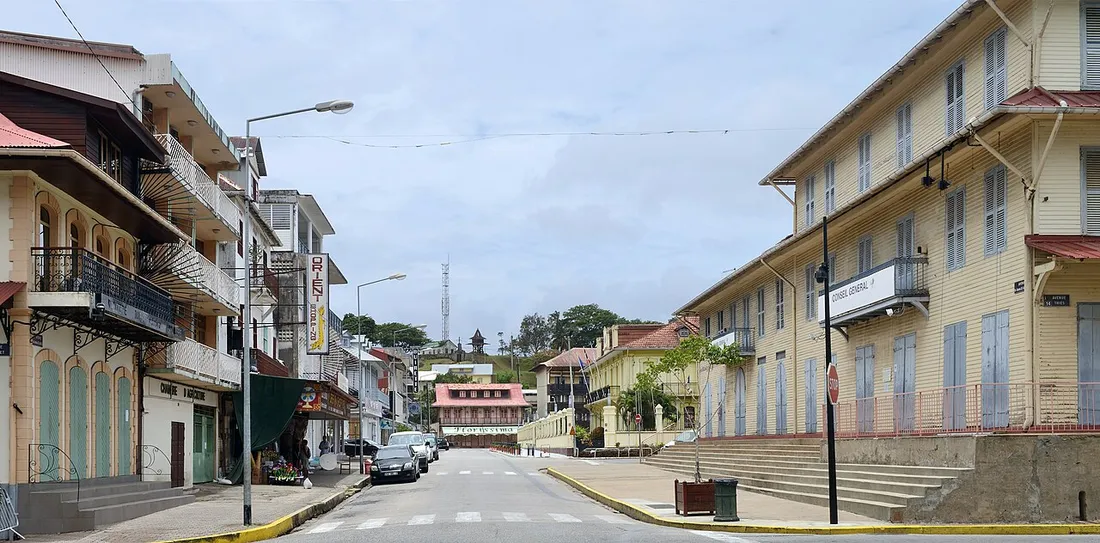
Avenue du Général-de-Gaulle à Cayenne, en Guyane, bordée de commerces et de bâtiments administratifs à volets bleus
Cayenne, principale destination des missions d'entreprise en Guyane. — © Cayambe (Wikimedia Commons, CC BY-SA 3.0)

Long stays and team rotations: the real strength of a complete home

In French Guiana, many assignments last not two nights but several weeks, or even several months. Over those durations, housing a team in an apartment or a villa changes everything compared with individual hotel rooms.

The comfort that makes a long assignment sustainable

A complete home brings concrete advantages for extended stays:

  • A fully equipped kitchen: nobody eats out lunch and dinner for six weeks — it is better for morale as well as for the budget.
  • Several bedrooms: everyone keeps their privacy, which matters when sharing accommodation as a team.
  • A shared living area: useful for debriefing a day on site or preparing an intervention.
  • An on-site laundry room: essential beyond a few days.

Budget-wise, long stays are generally negotiated on better terms than isolated nights. Rates vary with the season, the location and the duration: expect more favourable conditions by the month than by the night, though no single figure can be quoted since it depends entirely on your set-up. Price ranges are given in the quote, according to the period (the high tourist season and periods of intense activity put pressure on availability).

Managing rotations

For a construction site or a rotating assignment, logistics matter as much as the accommodation itself. Booking the same property for the whole duration, with occupants changing by rotation, avoids constant moves and secures availability. Linen management, housekeeping between rotations and key handover are all taken care of, freeing your assignment manager from time-consuming tasks.

Choosing the right location in French Guiana

The choice of area depends directly on where the assignment takes place. A few useful geographical pointers:

  • Cayenne: the administrative and economic centre. Handy for assignments involving institutions, company headquarters and Félix Éboué airport (located in Matoury). Areas such as the town centre, Montabo and the surroundings are in demand.
  • Rémire-Montjoly: a sought-after residential commune east of Cayenne, appreciated for its quieter setting, its beaches and its proximity to the urban area. A good compromise for team stays.
  • Matoury: immediately next to the airport and business zones, of interest for assignments with a lot of air rotations.
  • Kourou: essential for anything connected to the Guiana Space Centre and the space industry. Demand is high during launch campaigns.
  • Saint-Laurent-du-Maroni: in western French Guiana, relevant for assignments in that area (health, social services, planning, the border with Suriname).

The distance between the west (Saint-Laurent) and the Île de Cayenne represents several hours of driving: it is better to house the team as close as possible to the assignment site rather than multiplying daily journeys. To see examples of properties, browse our accommodation.

How a group booking works in practice

Here is the typical journey, from enquiry to assignment:

  1. Defining the need. You specify the dates, the number of people, the preferred location, the duration and your invoicing requirements (company name, SIRET, VAT, bank transfer).
  2. Proposal and quote. We suggest one or more suitable properties and a detailed corporate quote.
  3. Approval and deposit. Once agreed, the booking is secured according to the agreed terms.
  4. The stay. Welcoming the teams, key handover, associated services (housekeeping, linen) throughout the duration.
  5. Invoicing. Issuing of the invoice in the company’s name, with VAT where applicable, ready for your accounts and your expense claims.

This process applies just as well to a three-person trip over one week as to a team rotating over several months.

Planning ahead to secure availability

French Guiana has periods of strong pressure on accommodation: launch campaigns in Kourou, events, tourist seasonality. Booking early means getting the right property in the right place, especially for groups or long stays. Framing your needs early via contact us avoids nasty last-minute surprises.

Frequently asked questions

Can we have an invoice in the company’s name rather than the employee’s?

Yes — that is precisely the point of going through a para-hotel provider. You send us the company’s billing details (registered name, address, SIRET, VAT number if needed) and the invoice is issued directly in the company’s name, ready for your accounts.

Is payment by bank transfer possible?

Yes. Bank transfer is the recommended payment method for business stays. It saves the employee from fronting the costs and makes accounting reconciliation easier. For long assignments, periodic invoicing can be arranged.

Is VAT recoverable?

When VAT applies and appears on an invoice in the company’s name, it is in principle recoverable if the expense is incurred for business purposes. As French Guiana has overseas tax specificities, the exact situation should be confirmed with your accountant. We provide a compliant invoice; the tax treatment is a matter for your accounts department.

Do you handle long stays and team rotations?

Yes. We organise stays from several weeks to several months, including with occupants changing by rotation in the same property. Housekeeping, linen and key handover are taken care of between rotations.

How many people is a group booking intended for?

There is no rigid threshold: it ranges from a small group of two or three employees to a full team spread across one or more villas or apartments, depending on your headcount and where the assignment takes place. The quote adapts to your set-up.

In summary, and your next step

A well-managed group corporate booking means comfortable accommodation for your teams and friction-free administration: an invoice in the company’s name, a compliant expense claim, payment by bank transfer, VAT correctly stated where it applies, and terms suited to long durations. In French Guiana, where assignments take place in Cayenne just as much as in Kourou or in the west, choosing the right property in the right place saves everyone time and stress.

For a team stay or a long assignment, request a corporate quote via contact us. We will put together a proposal tailored to your dates, your headcount and your invoicing requirements. To find out more about our approach and our services, discover our concierge service, browse our accommodation or explore the blog for more practical guides to French Guiana.

🧭 Which stay suits you?

3 questions, 20 seconds.

Also read