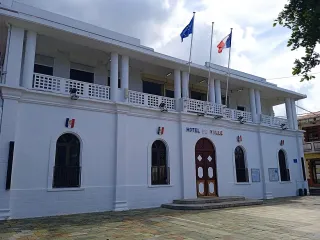

“I’ve been renting on Airbnb for two seasons already — do I really have to go to the town hall?” The answer is yes, and I repeat it to every owner I work with. The furnished tourist rental declaration in Martinique is not an optional formality: it’s a legal obligation that comes before the very first night, and it applies across the whole island. As a local concierge service, we file these dossiers all year round. Here is the procedure, town by town, the role of the seasonal rental registration number, and what you risk if you ignore it.
Why declaring a furnished tourist rental is mandatory in Martinique
Martinique is a French overseas department and region (DROM): the Tourism Code applies there word for word, exactly as in mainland France. A furnished tourist rental — a villa, studio, one-bedroom flat, or bungalow rented to passing guests who do not take up residence there — must be declared at the town hall before being offered for rent (article L.324-1-1), whether you rent year-round or just three weeks during Lent.
Beyond the law: without a declaration, your listing is in breach and the platforms take it down; declared status conditions the micro-BIC tax allowance and the star rating; and a property in good standing reassures the traveler.

The declaration procedure, step by step
The exact route depends on your town, but the common core never changes.
Step 1: determine the property’s status
Is your property your primary residence (occupied more than eight months a year, with rentals capped at 120 days/year) or a second home (stricter rules, possible change-of-use)? This status determines the regime, but it never exempts you from the declaration.
Step 2: Cerfa 14004 or online declaration
Two scenarios in Martinique. In towns without online declaration, you fill out the Cerfa form no. 14004: the Cerfa 14004 in Martinique records the landlord’s identity, the address of the rental, its capacity (rooms, beds, occupants), and the rental periods, then is filed at the town hall or sent by registered mail. In towns with online declaration, an online service replaces the paper form and generates your registration number.
Step 3: display the registration number
Where registration has been introduced, the online declaration issues a thirteen-character registration number. This seasonal rental registration number must appear on all your listings (Airbnb, Booking, Abritel, direct site). Without it, where it is required, the platform can suspend your listing overnight.
Step 4: keep the receipt
The town hall gives you a receipt (or an acknowledgment of online declaration): file it away — it’s your proof in the event of a municipal inspection.
The declaration town by town in Martinique
The principle is national, but the tool — paper Cerfa or online declaration — varies according to each municipal council’s resolution. Always check the current situation with the town hall.
- Fort-de-France: the administrative center (~360,000 inhabitants in Martinique), the most tightly regulated town. Mandatory declaration, registration number, and maximum vigilance on the change-of-use of second homes: do your research before buying.
- Les Trois-Îlets (Pointe du Bout, birthplace of Joséphine de Beauharnais) and Sainte-Anne (Les Salines, Pointe Marin): among the strongest seaside demand on the island, declaration and number essential, star rating recommended.
- Le Diamant (facing the Rock), Le François (white-sand shallows), La Trinité / Tartane (Caravelle, surf), and Saint-Pierre (Mount Pelée, UNESCO ruins): looser regulation, but declaration always required.
Your guests land at Aimé Césaire Airport (Le Lamentin), 45–60 minutes from the southern beaches: a car is strongly recommended (€30 to €50/day).
Cost, timeframe, and documents to prepare
The declaration and the registration number are free: beware of private sites that charge €30 to €80 for a simple Cerfa submission. The receipt is often immediate with online declaration, and takes from a few days to two weeks for a paper filing. Prepare an ID document, proof of ownership (or a lease authorizing subletting), and the property’s characteristics (floor area, rooms, sleeping arrangements). Only the star rating (1 to 5 stars), which is optional, costs money: €150 to €300 through an accredited body.