Booking accommodation in French Guiana is unlike anywhere else in France’s overseas territories: a limited supply, split between three hubs several hours apart by road, and a phenomenon unique in the world, the price surge on rocket launch nights. After several years housing travellers between Cayenne and the Maroni, here is what you need to know before locking in your dates: which base to choose, at what price, and how far ahead depending on the season.
Where to stay in French Guiana: three bases, three travel logics
French Guiana is the size of Portugal for nearly 294,000 inhabitants, almost all on the coast along the RN1. A car is essential and your choice of base shapes the whole itinerary; our French Guiana guide covers each area in detail.
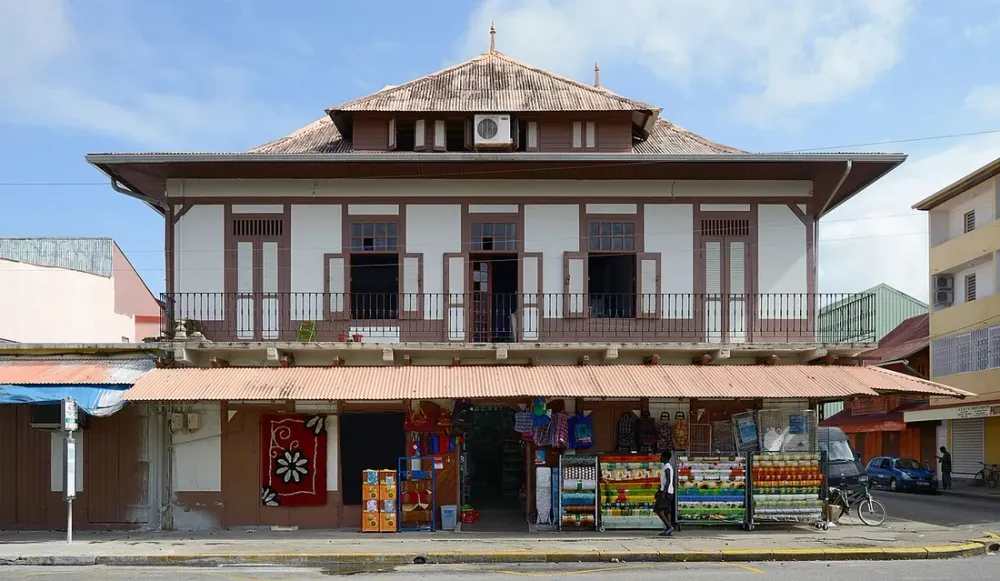
Cayenne and Remire-Montjoly: the most versatile base
The administrative capital and its neighbouring residential town hold most of the territory’s holiday rentals. It is the right choice for a first stay:
- Access: Félix-Éboué airport (Matoury) is 13 km away, 15-20 minutes from the centre.
- On site: the Cayenne market (Friday and Saturday morning, the not-to-be-missed pho soup), the place des Palmistes, the Montjoly beaches where turtles sometimes nest.
- Excursions: the Kaw marshes and Roura at 1 hr to 1 hr 30, Cacao and its Hmong community at 1 hr 15, Kourou at 1 hr.
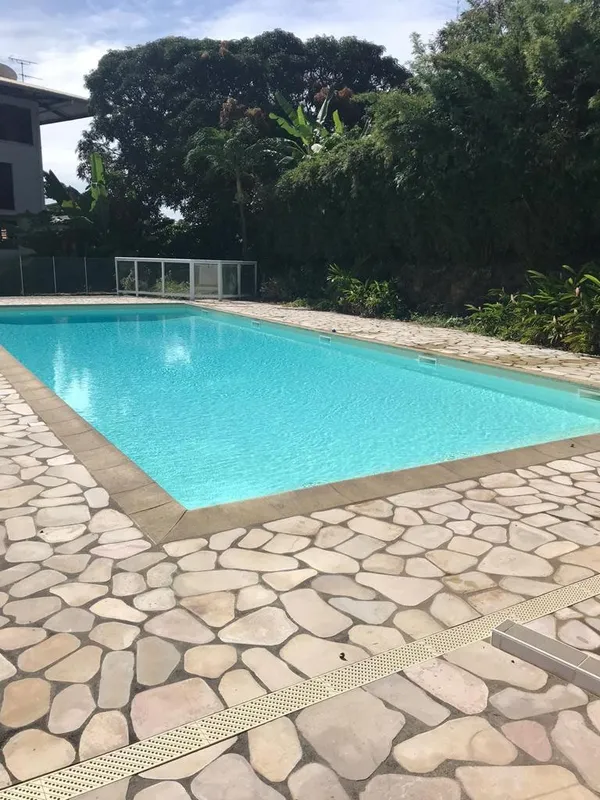
- Observed rates: a decent studio in Cayenne €55-75 a night, an air-conditioned two-bedroom €90-120, a villa with pool in Remire-Montjoly €140-200.
Remire-Montjoly, pricier but more residential (coastal trails, beaches on foot), is our recommendation for families and stays of more than four nights.
Kourou: the space town, handy but tight
Kourou, 60 km from Cayenne (45 minutes via the RN1), runs to the rhythm of the Guiana Space Centre, which can be visited free of charge by reservation. It is also the departure point for the Îles du Salut.
- Rates outside launches: a one-bedroom €65-90 a night, a house €110-150.
- Plus: the catamaran for the Îles du Salut leaves around 8 a.m., so it is better to sleep on site the night before.
- Limit: a smaller supply than in Cayenne and extreme price volatility during launch weeks (see below).
Saint-Laurent-du-Maroni: the gateway to the West and the river
250 km from Cayenne (3 hr to 3 hr 30 by road), Saint-Laurent deserves at least two nights: the Camp de la Transportation and penal-colony history, pirogues on the Maroni, and access to Awala-Yalimapo for the nesting of leatherback turtles (April to July).
- Rates: a guesthouse room €50-70, a cottage or one-bedroom €60-85 a night.
- Field tip: avoid a same-day round trip from Cayenne, the RN1 at night is tiring.
What about the interior? Carbets and lodges from Roura to Kaw
For one or two nights of immersion, the carbet (an open shelter where you sleep in a hammock under a mosquito net) remains the quintessential Guianese experience: €15-30 a night in a hammock, €40-80 for an equipped lodge around Roura or Cacao. Book them like excursions, alongside a base on the coast.
Accommodation rates and Ariane launches: anticipating the launch surge
This is THE local feature travellers discover too late. Every Ariane 6 or Vega launch draws engineers, subcontractors, journalists and onlookers: from Kourou to Sinnamary, accommodation fills up weeks in advance. Here is what we observe in every campaign:
- D-30 to D-15: Kourou hotels show full, holiday rentals follow.
- Rates: +30 to +60% in Kourou the week of the launch; a one-bedroom at €75 easily rises to €110-120 a night, with a 2-3 night minimum stay.
- Domino effect: demand spills over to Macouria then Cayenne, 1 hr by road from the observation sites.
- A risk to factor in: a launch can be postponed by 24-72 hr (weather, technical). Check the cancellation policy and allow a buffer night.
Three reflexes to book smart around a launch:
- Watch the launch calendar published by CNES/Arianespace and book as soon as the window is announced.
- Sleep in Macouria or Cayenne if Kourou is full: the observation points (Kourou and Carapa beaches) remain reachable by car.
- Favour flexible cancellation: at Hostel Toucan, cancellation is free up to 7 days before arrival, which covers most launch postponements announced ahead.
Conversely, if rockets are not your thing, avoid these dates: you will travel cheaper.
When to book: seasons, carnival and realistic lead times
The dry season, July to late November
The best period: passable tracks, more comfortable outings to Kaw and treks, clear skies for the launches. It is also the high season, which overlaps with the August and October holidays. Book 2 to 3 months ahead, especially for the Remire-Montjoly villas.
Carnival, from January to February-March
One of the longest carnivals in the world: every weekend between Epiphany and Ash Wednesday. Cayenne fills up, prices rise by 15 to 30% and the touloulou masked-ball Saturdays book up early. Plan 6 to 8 weeks ahead.
The rainy season, from December to June
Outside carnival, the most flexible period: wide availability, negotiable rates on long stays, a spectacularly green forest. The “little summer of March” often offers a dry window. Booking 3-4 weeks ahead is enough.
The trap of work stays and missions
A little-known point: French Guiana hosts a steady flow of professional missions (space, construction, health, administration) that take up well-located homes in Cayenne and Kourou for medium-term stays. Hence the value of booking early, even outside school holidays.