You are preparing a job transfer, a move from mainland France or a complete change of life towards French Guiana, and the first question that always comes up is housing. How much does it cost to rent in Cayenne? Which neighbourhoods should you target depending on your budget, your family and your workplace? The reality is that the Cayenne rental market is tight, uneven, and varies enormously from one area to the next. The figures given here are provided purely as an indication: they depend on the season, the condition of the property, whether it is furnished or not, how close it is to the centre or the coast, and above all on what is actually available when you start looking. Treat them as benchmarks to frame your budget, never as guaranteed prices. The aim of this article is to give you an honest mental map of Cayenne and its surroundings, so you arrive prepared rather than caught off guard.
Understanding the Cayenne rental market before you start looking
Cayenne, the capital of French Guiana, concentrates most of the territory’s administrative, hospital and commercial employment. That centrality creates constant pressure on housing: many newcomers (civil servants, healthcare staff, teachers, contract workers, military personnel) are searching at the same time, often around the same transfer periods, between June and September.
A few local realities to keep in mind before comparing rents:
- The urban area extends well beyond Cayenne proper. Many people live in Rémire-Montjoly or Matoury, the neighbouring towns, while working in Cayenne. These towns are part of the same day-to-day living area.
- The equatorial climate affects your budget. Air conditioning, humidity and upkeep weigh on running costs. A well-ventilated or well-insulated home often rents for more, but costs less in electricity.
- The furnished / unfurnished distinction is a major one. For a first move, furnished accommodation (or temporary serviced accommodation) is often the starting point, while you look for a longer-term unfurnished home.
- Seasonality matters. Between the high tourist season, the transfer period and the rainy season, availability and prices shift. Hence the recurring “depending on the season” caveats throughout this article.
Furnished, unfurnished or temporary: where should you start?
Many newcomers underestimate the time it takes to find the “right” unfurnished home, view it, put a file together and get the keys. A common and sensible strategy is to first secure temporary furnished accommodation on arrival, then search locally once you are settled, with the time to genuinely explore the neighbourhoods. That is exactly what serviced accommodation allows: arriving stress-free, dropping off your bags, and then house-hunting with full knowledge of the ground.
Central Cayenne and the historic neighbourhoods
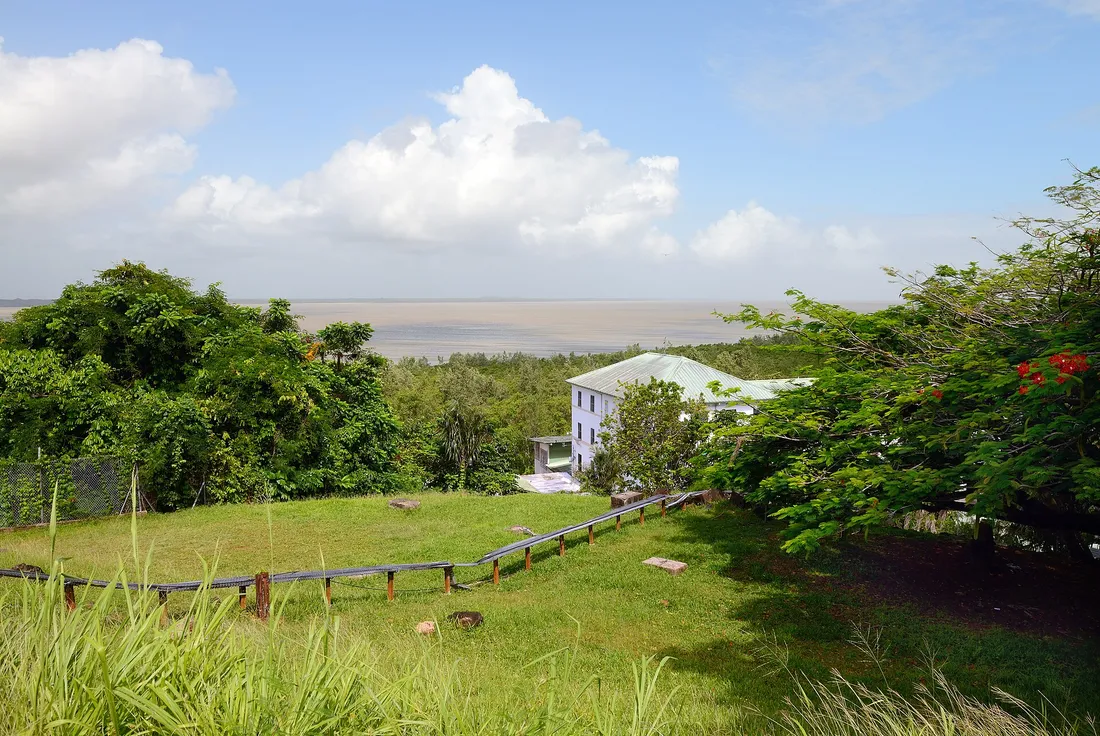
Cayenne town centre (the Village Chinois, the old centre around the Place des Palmistes, La Crique) offers character, proximity to shops and government offices, and a Creole urban atmosphere. It is the most genuinely “city-like” area in French Guiana.
- Strengths: almost everything within walking distance, markets, restaurants, cultural life, public services close by.
- Points to watch: some older properties are run-down or poorly insulated, parking can be difficult, and certain streets are livelier at night.
As an indication, for a studio or a small one-bedroom flat in the centre you should often budget in the region of €550 to €800 per month, depending on condition, whether it is furnished and the exact street. A family-sized three-room flat in good condition naturally goes above that. These amounts remain benchmarks: a renovated, air-conditioned property will sit at the top of the range, an older one at the bottom.
The residential neighbourhoods close to the centre
Around the centre, neighbourhoods such as Montabo, Bourda and Mont Baduel offer a compromise between proximity and relative quiet. Montabo in particular is prized for its location, its views and its closeness to the sea, which pushes rents upwards for the best-positioned properties.
Rémire-Montjoly: the sought-after residential area
A highly sought-after neighbouring town, Rémire-Montjoly is often the first choice for families and professionals relocating. You will find recent housing developments, beaches nearby (Montjoly, Rémire), well-regarded schools and a greener, quieter setting than in the town centre.
- Strengths: beaches, recent residences, schools, family atmosphere, a generally good sense of safety in several areas.
- Points to watch: some of the highest rents in the urban area, commuting times to plan for at peak hours, and strong demand meaning very little availability.
As an indication, a three-room flat in good condition in Rémire-Montjoly frequently sits in the region of €900 to €1,400 per month, more for a detached house with a garden or for properties close to the coast. Small furnished units remain rare there and are snapped up quickly.
Matoury and the airport corridor
Matoury, another town in the urban area, stretches along the road leading to Félix Éboué airport. It is a developing area, often slightly more affordable than Rémire-Montjoly, with suburban zones and recent developments (Balata, Cogneau-Lamirande, La Désirée, among others).
- Strengths: often an attractive space-to-price ratio, close to the airport and business zones, recent housing.
- Points to watch: some areas are far from shops, a car is virtually essential, and travel times into Cayenne vary greatly depending on the sector.
As an indication, a three-room flat in Matoury is often found in the region of €800 to €1,200 per month depending on location and condition, with houses able to exceed that benchmark. For a first budget, Matoury is often a good compromise between cost and comfort.