
Hostel Toucan — Apartments & Hotels
Menu

Business stays

Accommodation expense claims in the French overseas territories: the rules

Published on July 30, 2026 · by Ismael Samuel

Accommodation expense claims in the French overseas territories: the rules

Sending an employee to Martinique, Guadeloupe or French Guiana for a mission lasting a few nights or several weeks quickly raises the same question on their return: how do you claim the accommodation as a business expense without it being rejected by accounting or the tax authorities? Between the invoice in the right name, recoverable VAT, the accepted payment method and the company’s internal caps, a poorly documented stay can be costly. This article sets out, factually, the rules that govern accommodation expense claims in the overseas territories, and what distinguishes para-hotel accommodation designed for businesses from a simple holiday rental.

What an accommodation expense claim must contain

An expense claim is not just a receipt: it is a supporting accounting document. For an accommodation expense to be accepted as a deductible charge for the company, it must rest on a compliant and complete document.

In practice, the expected supporting document (invoice or accommodation note) must state:

  • the corporate name and address of the accommodation provider, along with its SIREN/SIRET number;
  • the identity of the client, ideally the name of the company paying, and not the employee’s name alone;
  • the exact dates of the stay (arrival and departure) and the number of nights;
  • the breakdown of services (overnight stay, any breakfast, cleaning, tourist tax);
  • the amount before tax, the VAT rate and amount, and the amount including all taxes;
  • the date of issue and a unique invoice number.

A handwritten receipt with no SIRET, or a screenshot of a booking on a mainstream platform, offers far weaker evidential value. This is one of the first points of friction when booking accommodation directly between individuals.

The professional purpose of the trip

Beyond the document, the company must be able to tie the expense to a professional purpose: mission, worksite, audit, training, trade fair, client meeting. It is wise to keep, alongside the invoice, a mission order or a simple internal email specifying the purpose, the destination (Cayenne, Fort-de-France, Pointe-a-Pitre, etc.) and the duration. In the event of an audit, this set of elements justifies that the charge genuinely relates to the business.

Mains d'une personne calculant des notes de frais avec une calculatrice et des recus de depenses professionnelles poses sur un bureau
Recus, factures et calculatrice : la note de frais d'hebergement en outre-mer suppose des justificatifs conformes aux plafonds en vigueur. — © Photo Karolina Grabowska (Pexels)

Invoice in the company’s name: why it is decisive

This is probably the most important distinction between business accommodation and a classic seasonal rental. Two logics coexist:

  • The employee pays upfront, then gets reimbursed. The invoice is often in their name, and the company reimburses them via an expense claim. The expense remains deductible if the purpose is professional, but VAT recovery is more fragile and the employee’s cash flow is tied up.
  • The company is the client and recipient of the invoice. The host invoices the company directly, with its corporate name and SIREN. This is the cleanest configuration from an accounting standpoint: the charge is clearly tied to the company, payment can be made by bank transfer, and analytical tracking is simplified.

In para-hotel accommodation, a host used to business stays can issue an invoice directly in the company’s name. This is a real differentiator compared with a holiday rental between individuals, where at best you only get a platform receipt in the traveller’s name.

VAT on accommodation in the overseas territories

The question of VAT is specific in the overseas departments, and it deserves to be handled with caution.

Different rates depending on the territory

In Guadeloupe and Martinique, VAT applies at rates specific to the overseas departments (DOM), distinct from those of mainland France. In French Guiana, VAT is not, to date, applicable in the same way as in the other departments: many services are outside the scope of VAT there. In concrete terms, an accommodation invoice in French Guiana may show no recoverable VAT, whereas a Martinique or Guadeloupe invoice will show some.

These rules evolve and include special cases: it is essential to have the exact treatment validated by your chartered accountant, depending on the territory and the precise nature of the services invoiced.

VAT on accommodation: recovery is restricted

Even when VAT appears on the invoice, its recovery by the company follows specific rules. Accommodation expenses incurred for directors or employees are subject to well-known restrictions regarding the right to deduct. On the other hand, VAT on clearly identified ancillary services may follow a different regime. Here again, only a detailed invoice, line by line, allows your accountant to decide. A lump-sum note (stay: X euros) deprives the company of any possibility of analysis.

The payment method: why bank transfer changes everything

On an expense claim, the payment method is not neutral. Three configurations come up regularly:

  1. Payment by the employee (personal card, cash), then reimbursement: simple but inelegant in terms of cash flow and sometimes a source of internal disputes.
  2. Payment by the company’s business card: the expense is directly tied to the company, which makes bank reconciliation easier.
  3. Payment by bank transfer from the company to the host, against an invoice: this is the clearest solution for long or recurring stays, and the most reassuring for an audit.

Business-oriented para-hotel accommodation accepts bank transfer against an invoice, which allows the company to pay directly, to spread payments over long stays and to avoid the employee having to advance large sums. For a worksite of several weeks in French Guiana or a long mission in Martinique, this flexibility makes a real difference.
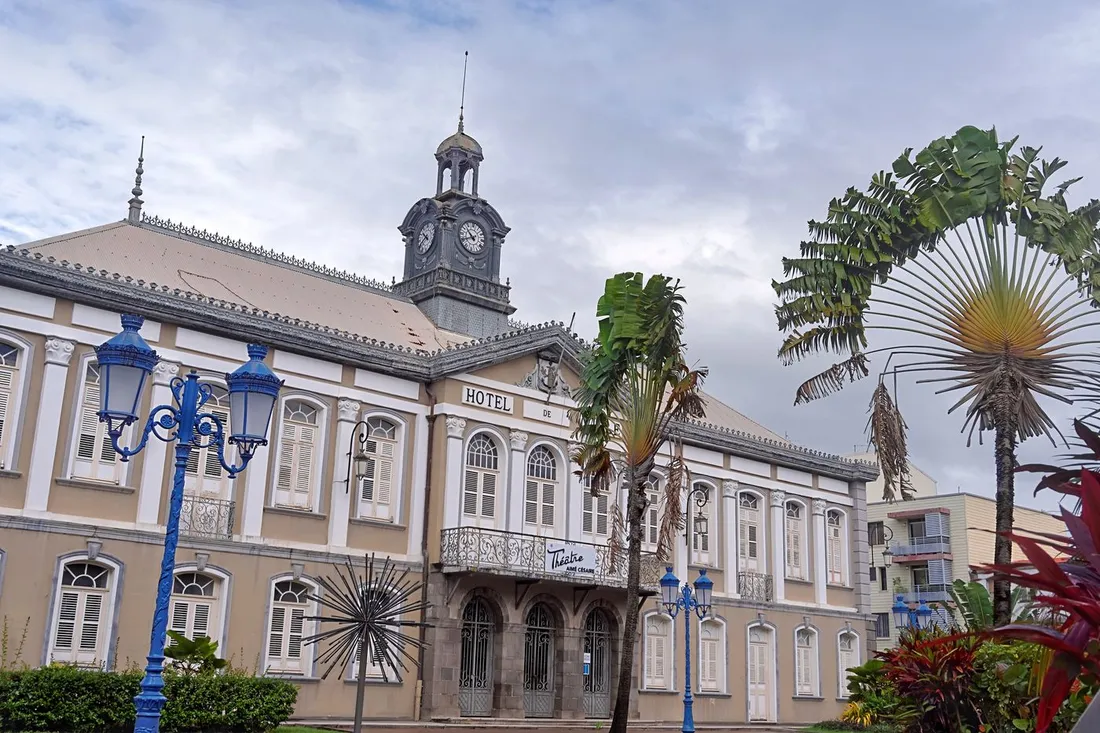

Ancien hotel de ville et theatre de Fort-de-France en Martinique, batiment colonial a l'horloge entoure de palmiers
Fort-de-France, en Martinique : loger une equipe en mission dans les Antilles-Guyane implique des regles de note de frais specifiques a l'outre-mer. — © JLXP (Wikimedia Commons, CC BY-SA 4.0)

Long stays: the strength of para-hotel accommodation for missions

The French West Indies and French Guiana concentrate a great deal of long-term business travel: construction worksites, technical missions, the space sector in French Guiana, healthcare, audits, training. For these stays of several weeks, the classic hotel quickly becomes costly and poorly suited to an employee’s daily life.

Furnished para-hotel accommodation provides an intermediate answer: the comfort and independence of a home (kitchen, washing machine, workspace), with the services and invoicing of a professional host. For the company, the advantages are concrete:

  • a per-night cost that drops with duration, through decreasing weekly or monthly rates;
  • a single, compliant invoice in the company’s name, simpler to process than a multitude of receipts;
  • payment by bank transfer that can be spread over the duration of the mission;
  • a living environment that improves the comfort of the employee posted far from home.

Indicative cost ranges

Purely for guidance and with no contractual value, a good-quality furnished home in the French West Indies and French Guiana often falls within a range of around 70 to 150 euros per night for short stays, with monthly rates that can bring the per-night cost significantly lower on long missions. These orders of magnitude vary depending on the season, the location, the capacity of the home and the services included. For a precise quote tailored to your mission, the simplest option is to request a quote.

Pitfalls to avoid on an overseas expense claim

Some mistakes come up often and weaken deductibility:

  • booking via a mainstream platform and getting only a receipt in the traveller’s name, without the host’s SIRET;
  • failing to keep the breakdown of the invoice (overnight stay, cleaning, tourist tax), which prevents any fine-grained VAT treatment;
  • confusing professional and private expenses when a stay mixes mission and days off;
  • exceeding, without justification, the company’s internal caps set by the expense policy;
  • forgetting to tie the expense to a documented professional purpose.

Checklist before leaving on a mission

  • Check that the host can invoice in the company’s name (corporate name, SIREN on the invoice)
  • Confirm the accepted payment method (bank transfer against invoice for long stays)
  • Request a detailed invoice stating VAT, dates and services
  • Keep the mission order or the email specifying the professional purpose
  • Check consistency with the internal expense policy (caps, categories)
  • Archive the invoice and supporting documents for accounting and a possible audit

Frequently asked questions

Must the invoice be in the company’s name?

It is not always mandatory for the expense to be deductible, as long as the professional purpose is established. But an invoice in the company’s name is clearly preferable: it secures the deduction, facilitates VAT recovery when it applies and simplifies accounting. This is precisely what a para-hotel host allows, unlike a rental between individuals.

Can VAT be recovered on accommodation in French Guiana?

In French Guiana, many services are outside the scope of VAT: the accommodation invoice may therefore not include recoverable VAT. In Guadeloupe and Martinique, VAT applies at rates specific to the overseas departments, with deduction rules specific to accommodation expenses. Always have the exact case validated by your chartered accountant depending on the territory.

Is payment by bank transfer essential?

No, but it is strongly recommended for long or recurring stays. A bank transfer from the company to the host, against an invoice, offers the best traceability, avoids the employee having to advance large sums and makes it easier to spread payments over several weeks of a mission.

How do you handle a long mission of several weeks?

Favour furnished para-hotel accommodation with a decreasing rate, a single invoice in the company’s name and payment by bank transfer. This formula reduces the per-night cost, simplifies the expense claim and improves the comfort of the posted employee, compared with a succession of hotel nights.

What supporting documents should be kept in addition to the invoice?

Keep the mission order or an internal email specifying the purpose and destination of the trip, proof of payment (bank transfer, business card statement) and, where applicable, documents related to the company’s expense policy. This set of documents secures the expense in the event of an audit.

Simplify your business stays in the French West Indies and French Guiana

Invoicing in the company’s name, paying by bank transfer, obtaining a compliant expense claim and benefiting from rates suited to long stays: this is exactly what our para-hotel approach offers in Martinique, Guadeloupe and French Guiana. Discover our accommodation suited to professional missions, explore our concierge service and browse the blog to go further.

For a tailored business stay and compliant invoicing, request a corporate quote in a few minutes: simply contact us.

🧭 Which stay suits you?

3 questions, 20 seconds.

Also read