
Are you preparing a job transfer, a career change or a whole new life in Guadeloupe, and wondering where to live while you look for your permanent home? It’s one of the most concrete — and most stressful — questions in any overseas relocation project. Signing a long-term lease from mainland France, without having seen the property or understood the geography of the archipelago, is risky. Temporary housing is precisely the solution that lets you breathe: you drop off your bags, you explore the towns, you meet landlords, and only then do you choose with full knowledge of the ground. Here is a factual guide to organising this stage calmly.
Why start with temporary housing when you arrive
Arriving in Guadeloupe isn’t just changing region: it means discovering an archipelago with its own codes, its real travel times (the traffic jams between Pointe-à-Pitre and Baie-Mahault are very real), its climate, and a rental market that is often tight in sought-after areas. Many newcomers who sign a lease remotely end up regretting their choice: a noisy neighbourhood, a longer commute than expected, or a property that doesn’t match the photos.
Temporary accommodation offers several advantages:
- Time to visit in person before committing for one or three years.
- Flexibility: no long commitment, ideal if your professional situation isn’t settled yet.
- A logistics base for your administrative formalities (setting up utilities, registrations, etc.).
- The chance to test a town before deciding to put down roots there.
- A move-in-ready furnished home, without having to ship your furniture by container from day one.
A shipping container from mainland France takes several weeks to arrive — often in the region of three to six weeks as an indication, depending on the carrier and the season. Furnished temporary housing naturally bridges that gap.

Understanding the geography: where to look based on your situation
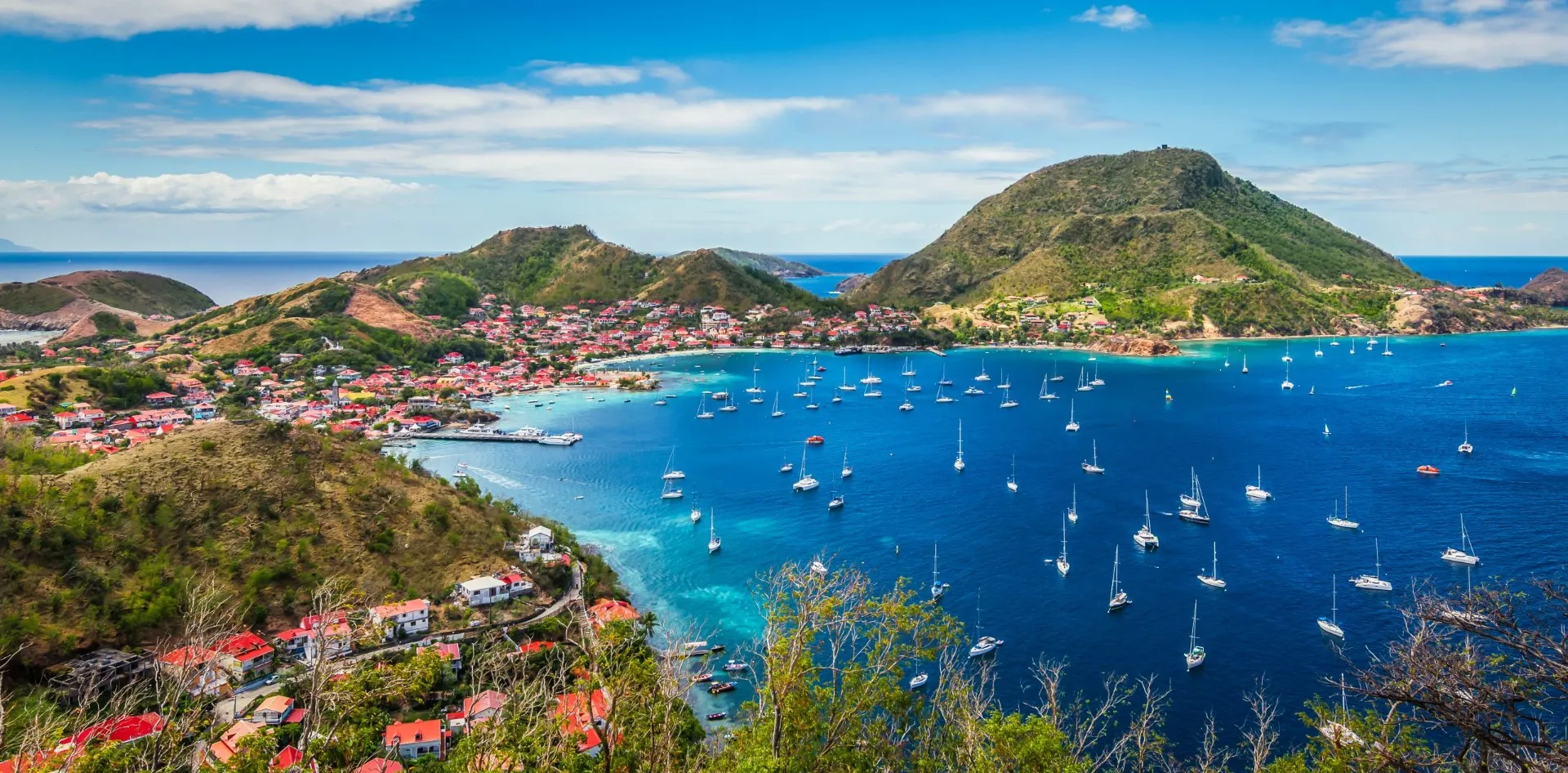
Guadeloupe is made up of two main islands linked by bridges (Grande-Terre and Basse-Terre), plus the southern islands (Marie-Galante, Les Saintes, La Désirade). Choosing your temporary base depends above all on where you’ll be working.
Grande-Terre: the economic and administrative hub
This is where the activity is concentrated. Pointe-à-Pitre and the central conurbation (Les Abymes, Baie-Mahault with its Jarry business zone, Le Gosier) hold most of the jobs, government offices and shops. If your job is in Jarry, at the CHU teaching hospital or in a public administration, targeting this area keeps your commute short.
- Le Gosier: highly sought after, seaside atmosphere, close to everything, rather upmarket.
- Baie-Mahault: practical for Jarry, modern, but very busy at peak hours.
- Le Moule, Saint-François, Sainte-Anne: to the east and south, beaches, pleasant setting, but further from the centre.
Basse-Terre: nature, quiet and administration
The town of Basse-Terre (the administrative capital) and its region offer a greener, mountainous setting, turned towards La Soufrière and the rainforests. Towns such as Petit-Bourg, Sainte-Rose or Bouillante appeal to those seeking nature, but distances to the economic hub in Grande-Terre get longer.
One piece of common-sense advice
Before fixing your temporary home, first identify your workplace, then choose a base within a reasonable distance. Nothing stops you from switching areas for your permanent home once you know the ground better.
The different temporary housing options
Several options exist, each with its own advantages depending on duration and budget.
Short- and medium-term furnished rentals
This is the most flexible option for a newcomer. A fully equipped furnished home (kitchen, linen, wifi) lets you live normally straight away, with no furniture to buy. Stays range from a few nights to several months. It’s the option best suited to a transition towards permanent settlement, because it combines day-to-day comfort with the absence of a long commitment.
This is exactly the type of accommodation we offer through our rentals: furnished, move-in-ready properties designed for transitional stays.
The “bail mobilité” (mobility lease)
Created for people on professional mobility (transfer, training, assignment), the bail mobilité is a furnished rental contract lasting one to ten months, non-renewable, with no security deposit payable. It may suit you if your situation falls within the cases provided for by law. Check your eligibility before committing.
Subletting or temporary flat-sharing
Economical, this suits tight budgets or people living alone. Be careful, though, about the legality of subletting (the landlord’s agreement is essential) and about how stable the arrangement is.
Hotels and tourist residences
Handy for the very first days, but the cost over several weeks quickly becomes high. Better kept for a very short-term stopgap.
Indicative budgets: what to expect
Prices vary widely depending on the town, the tourist season (high season, from December to April, pushes rates up), the floor area and the amenities. The benchmarks below are given purely as an indication and in no way constitute a price guarantee.
- Furnished studio or one-bedroom on a medium-term rental: a low to mid range, varying by area.
- Furnished two- or three-room flat: a bigger budget, especially in Le Gosier or Saint-François.
- High season: short-stay rates can climb sharply; plan ahead and book early.
- Utilities: water, electricity and internet are often added on, except with all-inclusive packages.
A few points to watch regarding the local cost of living, worth factoring into your overall budget:
- The cost of energy and of some imported goods is generally higher than in mainland France.
- Budget for transport: a car is virtually essential outside the central conurbation.
- The deposit and supporting documents required for a standard lease can be demanding; temporary options are often more flexible on this point.
For a quote tailored to your situation, the simplest thing is to get in touch: we adjust according to the length of stay and the season.