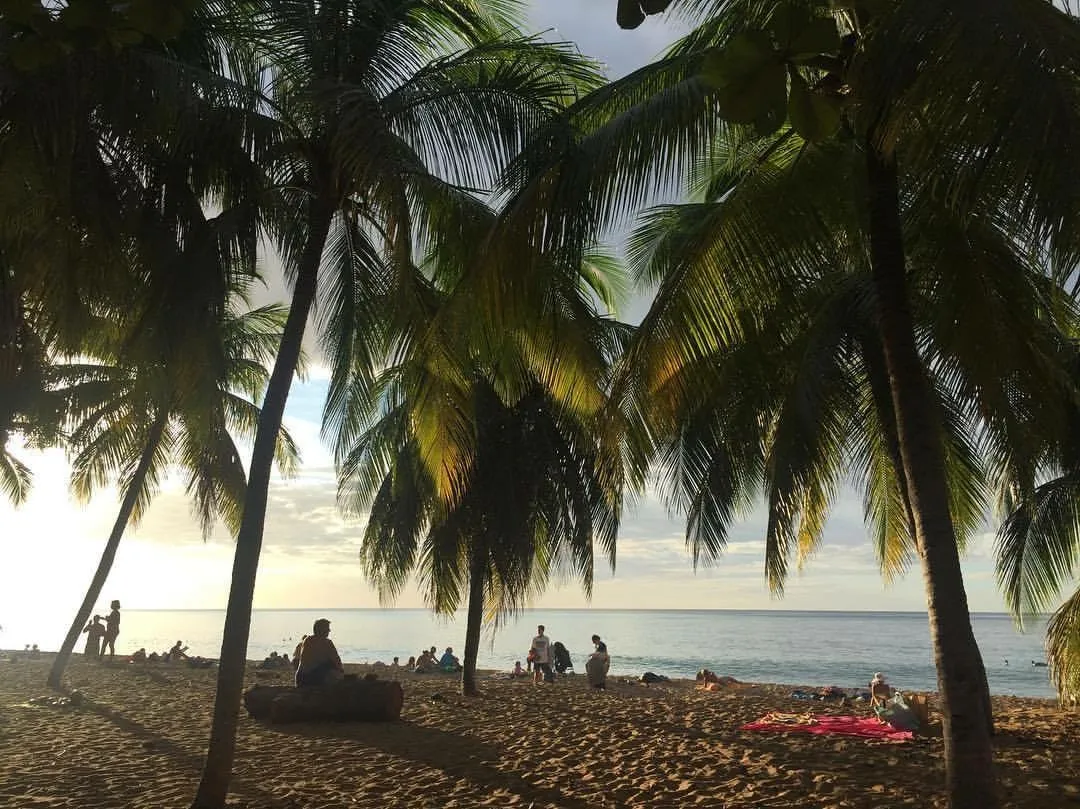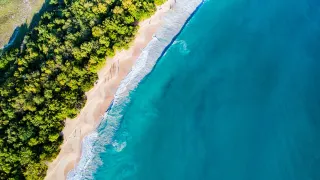
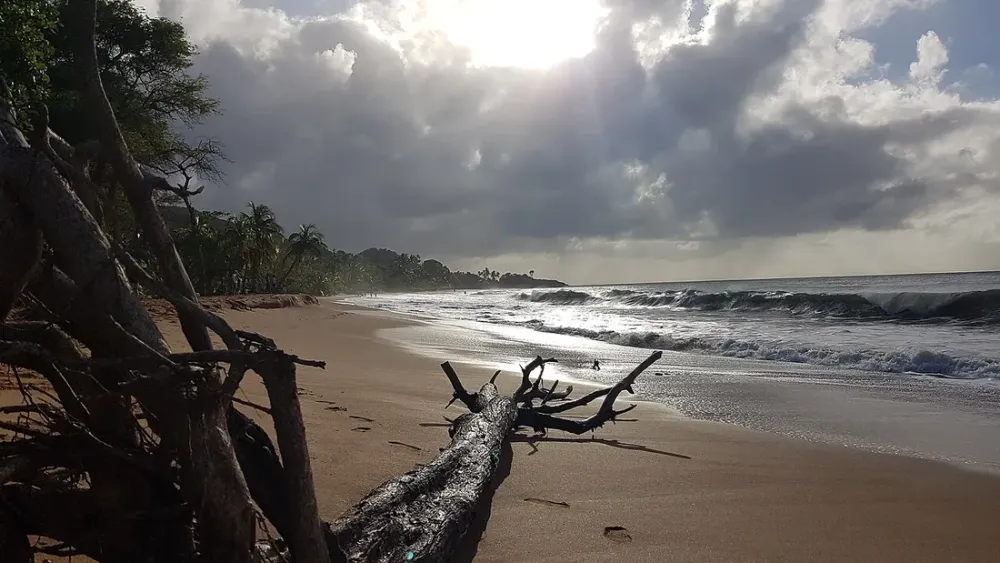
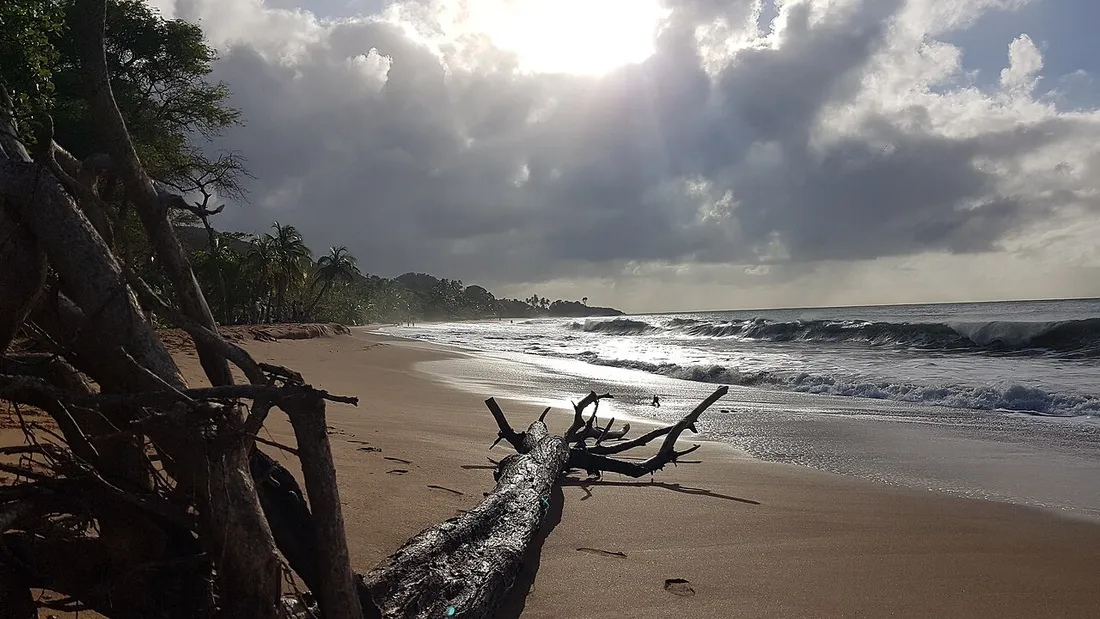
Lay your towel on the golden sand of Grande-Anse, in Deshaies, and you quickly understand why this beach appears on every Guadeloupe postcard. A gilded crescent of sand stretching more than two kilometres, leaning coconut palms, sea grape trees casting patches of shade, and as a backdrop the green hills of Basse-Terre’s leeward coast. It is one of the most beautiful beaches in the butterfly-shaped archipelago, and also one of the busiest.
But Grande-Anse is no swimming pool. Here, the Atlantic is never far away, and the swell can turn a peaceful dip into an exercise in vigilance. As hosts based in Deshaies, we send our travellers to this beach every week, and we have learned to pass on the three pieces of information that change everything: the tide, the current and the parking. Here is our field guide, no filter.
Grande-Anse Deshaies at a glance
Grande-Anse lies about 2 km north of the village of Deshaies, on the west coast of Basse-Terre. Plan for:
- 45 to 55 min by road from Pole Caraibes airport (Pointe-a-Pitre) depending on traffic;
- 35 to 40 min from the Cousteau Reserve (Malendure, Pigeon Islets), the No. 1 snorkelling spot;
- 1h15 to 1h30 from the turquoise beaches of Grande-Terre (Sainte-Anne, Le Gosier).
The beach faces west: it is one of the best places in Guadeloupe to watch the sun sink into the Caribbean Sea, around 6 pm in the dry season (December to April). That dry season remains the best time to visit, with a sea that is often more manageable and generous sunshine.
Tide and swell: understanding the water before you swim
First thing to know: in Guadeloupe, the tidal range (the difference between high and low tide) is small, on the order of 30 to 40 cm. The tide is therefore not the main concern for swimming, unlike in mainland France. What really matters here is the swell.
Grande-Anse receives trains of swell that break the waves directly onto the beach, creating a marked backwash, especially in the afternoon when the wind picks up. A few concrete benchmarks we share with our travellers:
- The morning (7 am to 11 am) is almost always the best moment: a flatter sea, light wind, clearer water.
- Low tide exposes a wider band of sand but can heighten the sense of slope and the shorebreak.
- After a depression or a windy spell, wait 24 to 48 hours: the residual swell makes swimming uncomfortable, even dangerous.
Before you set off, glance at the swell and warning bulletins (Meteo France Antilles publishes a colour-coded swimming alert). It’s free, it takes 30 seconds, and it spares you many a fright.
Current and rip: the golden rule of swimming
The real issue at Grande-Anse is the rip current, what locals sometimes call a “baine.” When the waves break hard, the water piled up on the beach flows back out to sea through narrow, powerful channels. You do not fight a rip current: you escape it by swimming parallel to the shore to get out of it, then heading back to the beach.
Our field-tested swimming advice:
- Swim in the supervised area when it is staffed. Grande-Anse has a lifeguard station in high season; respect the flag (green = ok, orange = caution, red = swimming forbidden).
- Stay where you can touch the bottom if you are not a seasoned swimmer. The seabed can drop away quickly.
- Never leave a child alone at the water’s edge: the backwash can knock you off balance even in 40 cm of water.
- Avoid swimming on a windy late afternoon, the time when currents are at their strongest.
- Favour the centre of the beach, often more sheltered than the ends where the swell wraps around.
For snorkelling, Grande-Anse is not the best spot (often choppy water, sandy bottom). If you are after fish and corals, head for the Cousteau Reserve in Bouillante. Grande-Anse is best enjoyed for relaxed swimming, the sand and the sunset.
Grande-Anse car park: peak hours and tips
Here is the most useful piece of information, the one nobody gives you before you spend 20 minutes circling for a space. The Grande-Anse Deshaies car park is free but limited, and it fills up fast.
From what we observe all year round:
- Before 9.30 am: no problem, you park as close as possible to the beach.
- Between 10.30 am and 3 pm in high season (December-April, school holidays, weekends): the main car park is full. You fall back onto the verges of the access road, sometimes a 5- to 10-minute walk away.
- After 4 pm: it frees up as families head home, and it is also the hour for sunset lovers.
Our host tips:
- Arrive early (before 10 am) and enjoy the calmest sea into the bargain.
- Or come at the end of the day for the sunset, leaving just afterwards.
- Never leave valuables in view inside the vehicle: that applies everywhere, here as elsewhere.
- Consider cycling or walking if you are staying in the village of Deshaies: 2 km of road, doable on foot for the most motivated, or a few minutes by bike.
If you are travelling without a car, be aware that the leeward coast is genuinely best explored with your own wheels. We steer our travellers towards renting a vehicle as soon as they arrive at Pole Caraibes; it is the comfort that opens up Grande-Anse, La Soufriere (1,467 m), the Carbet Falls and the National Park.