You have a week ahead of you and the urge to discover French Guiana without committing to a multi-day river expedition? Good news: the coastal strip concentrates most of the must-sees, and everything stays reachable by car. Here is a 7-day French Guiana itinerary that we have travelled and fine-tuned in the field over our years welcoming visitors, designed for first-timers who want something concrete, a good pace, and zero mandatory pirogue. Cayenne and its space coast, the Kaw marshes, the Salvation Islands, the Maroni River: we distil the essentials without rushing, with distances, budgets and local tips.
Before you go: what to know about French Guiana
French Guiana is a French overseas department and region (DROM) in South America, as vast as Portugal yet home to nearly 294,000 inhabitants, most of them settled along the Atlantic. You pay in euros, you speak French (but also Creole, Bushinengue and Amerindian languages), the dialling code is +594, and the time difference with Paris is -5h in winter and -6h in summer.
The Amazonian interior is fascinating, but it demands time, a substantial pirogue budget and sometimes several days of navigation on the Maroni or the Oyapock. For a first week, the coastal strip between Cayenne and Saint-Laurent-du-Maroni already offers: a Creole town, the Ariane rocket, a former penal colony, turtle-nesting beaches and culturally mixed villages. All of it linked by National Highway 1, in good condition.
Things to know before packing your bags:
- The yellow fever vaccine is mandatory to enter the territory. Book your appointment several weeks ahead, and at least 10 days before departure, at an approved international vaccination centre.
- A car is essential: distances are long and public transport almost nonexistent. Budget 35 to 60 €/day for a compact category, more in peak season.
- The best time is the dry season, from July to late November: passable tracks and more comfortable pirogue outings.
- Félix-Éboué airport is located in Matoury, 15 km from Cayenne, about twenty minutes away.
As French Guiana is a French department, no passport or visa is required for French nationals, but an ID document is requested, notably to visit the Guiana Space Centre. To dig deeper into logistics, climate and transport, see our complete guide to French Guiana.
Days 1 to 2: Cayenne and the Rémire-Montjoly peninsula
Day 1 — Settling into Cayenne
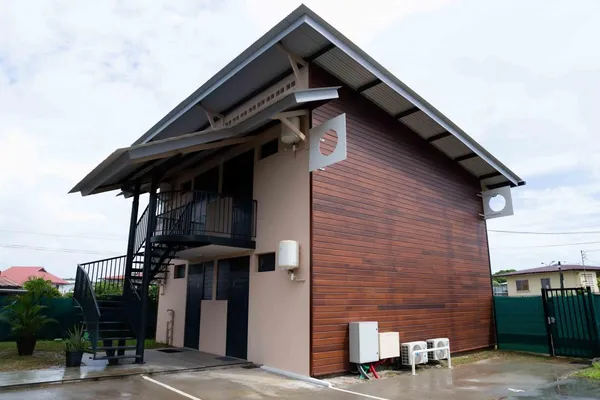
After arriving at Félix-Éboué, collect your car and head to your accommodation in Cayenne, the capital. About twenty minutes from the airport, the tropical-wood design apartments of the Cayenne Chic residence, in the Zac Hibiscus district make a straightforward first base for these two nights. Start gently: let the jet lag and the long flight wear off, and plan an early dinner.
The next morning (or on the first day if your flight lands early), head to the Cayenne market, open Wednesday, Friday and Saturday from 6 a.m. This is where you take the pulse of Guianese cultural blending: awara broth, pho soup inherited from the Hmong community, spices, unfamiliar fruits, woven baskets and local fruit juices. Budget 8 to 12 € for a hearty dish. Then stroll across the Place des Palmistes with its royal palms, then through the colourful streets of the historic centre lined with Creole houses.
Day 2 — Beaches and nature in Rémire-Montjoly
Fifteen minutes from Cayenne, Rémire-Montjoly lines up the finest accessible beaches on the coast: Montabo, Montjoly, Salines beach. The Rorota trail (a loop of about 2h, free) climbs through the forest to viewpoints over the ocean. Between June and August, at dusk, with a little luck and a great deal of discretion, you may sometimes witness sea turtles nesting at night — stay quiet and lamp-free. For this seaside interlude, the air-conditioned studios and apartments with a pool at Résidence Francis, in the Montabo district of Cayenne keep the beaches and the Rorota trail a few minutes’ drive away.
Good to know
- Local agricultural rum and the planteur cocktail are enjoyed everywhere: moderation is in order.
- Download your offline maps: 4G weakens as soon as you leave the towns.
- Budget for the first two days excluding accommodation: 30 to 50 €/day per person (meals, market, fuel).
Day 3: Kourou and the Guiana Space Centre
Heading west: Kourou is about 60 km from Cayenne, just over an hour’s drive.
The visit not to miss
The Guiana Space Centre offers free guided tours (by reservation, ID mandatory, about 3h). You discover the launch sites of Ariane 6 and Vega, the assembly building and the history of European spaceflight. Book several weeks ahead, especially in high season, as the slots fill up fast.
If your dates coincide with a rocket launch, reshuffle everything: watching a launch from a public viewing site is a once-in-a-lifetime experience — the rumble, the light, the trail across the sky. Viewing sites are announced by the CNES, and the schedule should be checked in advance; ask as soon as you book.
The afternoon in Kourou
- Visit the Space Museum to go deeper.
- Stroll along the seafront and the town of Kourou.
- Spot the jetty: this is where the boats leave for the Salvation Islands.
Sleep in Kourou or around Macouria to save time the next day.
Day 4: the Salvation Islands
The Salvation Islands archipelago (Île Royale, Île Saint-Joseph, Devil’s Island) is reached by catamaran from Kourou: about a 1h crossing, 45 to 65 € round trip, departure usually around 8 a.m., return in late afternoon.
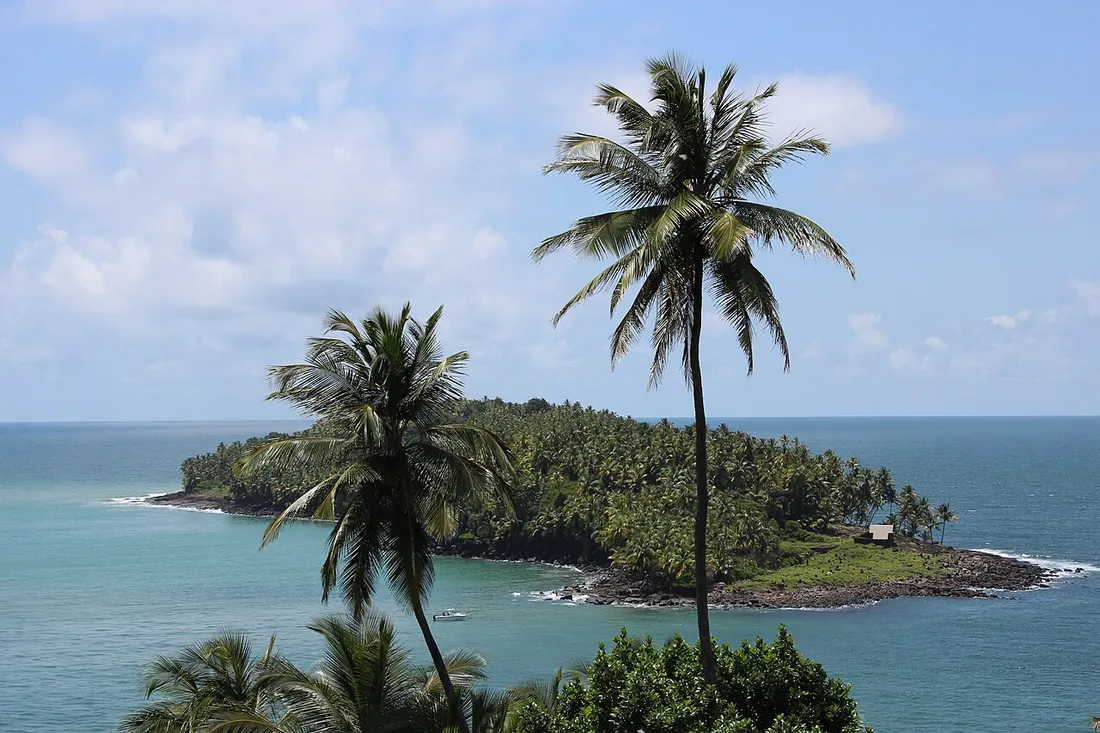
Grimly famous for their former penal colony — where Captain Dreyfus was held — these islands are now a verdant haven populated by monkeys, agoutis, macaws and peacocks.
On site, don’t miss:
- The tour of Île Royale on foot (1h30), between colonial ruins and viewpoints.
- Île Saint-Joseph and its solitary-confinement cells overgrown by the jungle (access by internal shuttle or by swimming depending on conditions — caution).
- A Creole lunch at the Île Royale inn (book the day before).
Devil’s Island cannot be visited (landing is prohibited), but it is perfectly visible from Île Royale. Bring closed shoes, water and sun protection: it is hot and humid.
Tight itinerary? Over seven well-filled days, it is hard to fit in both the full Space Centre tour and a full day on the Salvation Islands. If you would rather push on to the Maroni (see below), choose one or the other during the Kourou leg: the islands require a full day, even a night on Île Royale.
Day 5: the Kaw marshes and the detour via Cacao
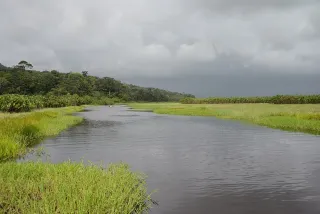
Heading back east, towards Roura and the village of Kaw (about 1h30 from Cayenne, or 2h from Kourou, including a winding stretch and a ferry crossing over the river). The Kaw marshes form one of the largest wetlands in France, a refuge for black caimans, scarlet ibis, hoatzins and a spectacular birdlife.
Book a motorised pirogue outing at dusk (35 to 50 €/person, 2 to 3h): it is at nightfall that the caimans’ red eyes appear in the beam of the lamps, against a backdrop of sunset and giant water lilies. It is the only truly recommended pirogue of the week, and it remains optional and short. Some operators offer a night in a floating carbet, well worth it if your schedule allows.
The detour via Cacao and the Hmong community
On the way, take a detour through Cacao, a village founded by Hmong refugees from Laos in the 1970s. Its Sunday morning market is an institution: Chinese soup for breakfast, traditional embroidery, vegetable gardens and Laotian cooking. The Maison de la Nature (entry about 5 €) houses an impressive collection of Amazonian insects, and a short forest walk rounds off the morning.