It’s 6:15 a.m. on the Route de la Traversée, the forest still dripping from the night’s rain, and a muffled drumming echoes through a red gommier tree: the Guadeloupe Woodpecker is hard at work. For anyone who loves birds, Guadeloupe (where birdwatching is possible year-round, a rare treat) is an exceptional playground: around 300 species recorded across the archipelago, of which just one is strictly endemic — and it’s precisely that bird everyone comes to find. After years of walking the trails of Basse-Terre with binoculars round my neck, here is my field guide to a successful birding trip in Guadeloupe: target species, exact spots, timing, gear and a realistic budget.
The Guadeloupe Woodpecker, the absolute star of birdwatching in Guadeloupe
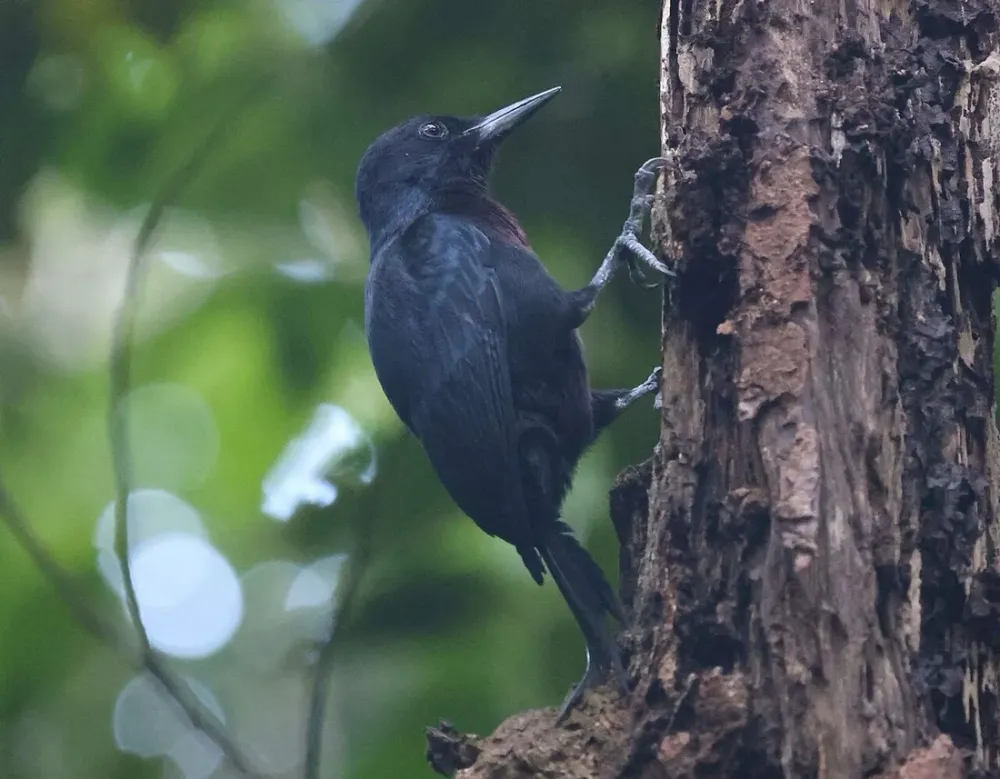
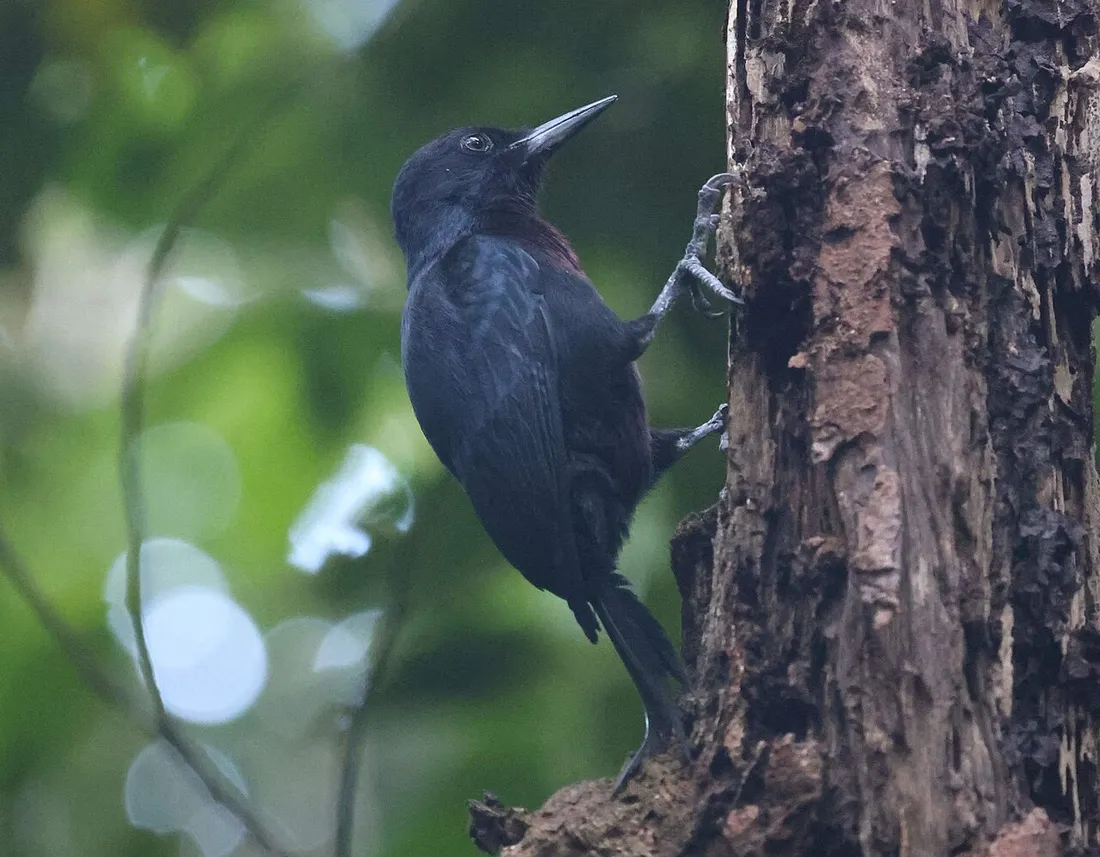
The Guadeloupe Woodpecker (Melanerpes herminieri), known as tapeur or toto-bwa in Creole, is the only bird in the world found nowhere but Guadeloupe. Entirely black with dark-red glints across the breast and about 26 to 28 cm long, it never migrates: it is born, nests and dies on the archipelago. The population is estimated at more than 10,000 pairs, 80% of them concentrated on Basse-Terre, where the large dead trees it needs to carve out its nest hole still survive.
How to spot it without a guide
- Listen before you look: its drumming is slower and more muffled than that of European woodpeckers, and its call is a nasal “wik” repeated over and over.
- Look for dead trunks: it forages in rotting wood at mid-height, rarely in the canopy.
- Stay still for 5 to 10 minutes: it isn’t a shy bird, but it is wary of movement. It almost always returns to the same trunk.
- Aim for the edges: contrary to popular belief, it’s easier to see in mid-altitude (mesophilic) forest, between 250 and 600 m, than deep inside dense woodland.
My three best spots, tested dozens of times: the Maison de la forêt on the D23 (Route de la Traversée), the Cascade aux Écrevisses trail 2 km further on (an easy 20-minute loop, perfect with children), and the heights of Sofaïa in Sainte-Rose, where I get my most consistent sightings between 6:30 and 8 a.m.
Bananaquit and hummingbirds: the can’t-miss birds of the Creole garden
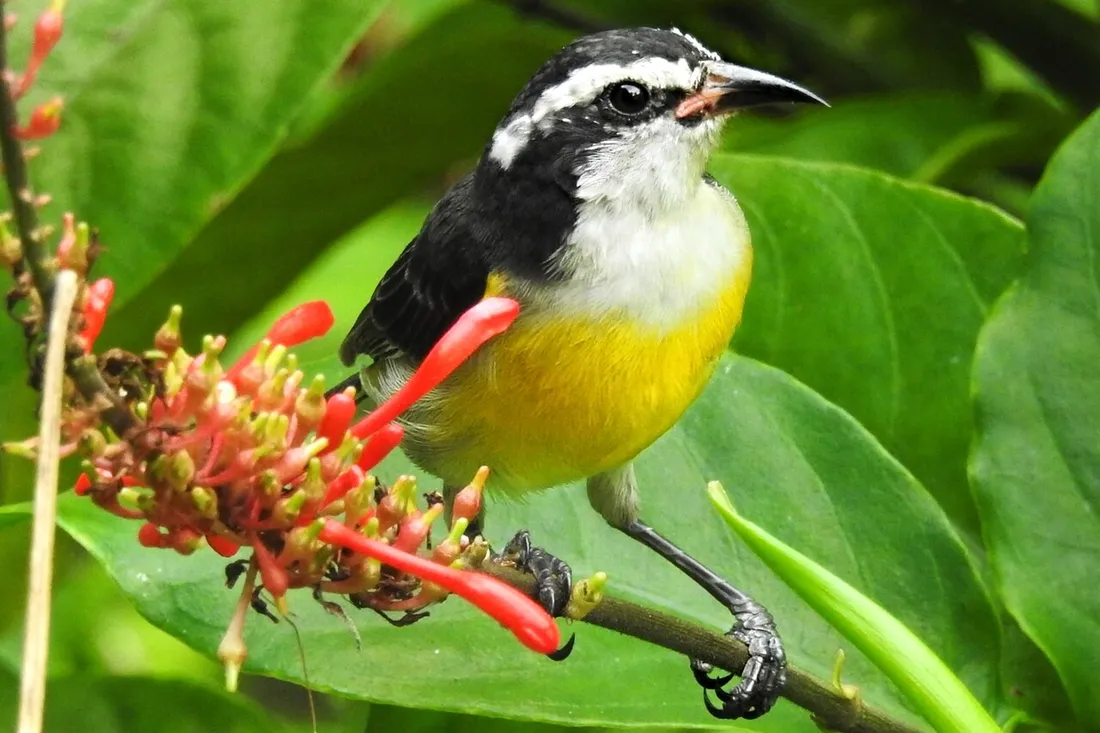
While the woodpecker takes a little effort, the Bananaquit (Coereba flaveola) will come straight to you. This little white-browed, bright-yellow-bellied passerine — the sikriyé — is the most visible bird on the archipelago: it pierces hibiscus flowers, pinches sugar off breakfast tables and nests in the bougainvillea of holiday cottages. Set out a small dish of sugar water on your terrace in Deshaies or Sainte-Anne and you’ll have a non-stop ballet from 6 a.m.
Three hummingbirds then share the spotlight:
- The Purple-throated Carib (Eulampis jugularis): the most spectacular, with a garnet throat and metallic blue-green wings, common on the heliconias and porcelain roses of Basse-Terre.
- The Antillean Crested Hummingbird (Orthorhyncus cristatus): tiny (8 cm), recognisable by its iridescent crest, found everywhere right into the gardens of Le Gosier.
- The Green-throated Carib (Eulampis holosericeus): with an emerald throat, more discreet, to be sought along the dry edges of Grande-Terre.
Round out your list with the Plumbeous Warbler, the Brown Trembler (which frantically shakes its wings, impossible to mistake), the Lesser Antillean Saltator and, along the coast, the Brown Pelican and the Magnificent Frigatebird patrolling above the Cousteau Reserve at Bouillante.
Birdwatching in Basse-Terre: the trails that truly deliver
The Guadeloupe National Park covers 17,000 hectares of tropical forest and holds most of the best sightings. My standard three-morning circuit, with an ideal base in Deshaies or Bouillante:
Day 1 — Route de la Traversée (D23)
Reach the Maison de la forêt car park before 6:30 a.m. (a 30-minute drive from Deshaies, 40 from Pointe-à-Pitre). Allow 2 to 3 hours on the free, waymarked loops. Targets: Guadeloupe Woodpecker, Plumbeous Warbler, Purple-throated Carib. Light rain is your ally: activity explodes just after a shower.
Day 2 — Grand Étang and the Carbet Falls
In Capesterre-Belle-Eau, the loop around Grand Étang (1 hr 15 of easy walking) offers Green Herons, coots and Grey-necked Wood-Rails in a magnificent mountain setting, beneath La Soufrière (1,467 m). Free access; the Carbet Falls car park is €2.50 per adult.
Day 3 — Sofaïa and Pointe Allègre
The Sofaïa springs trail (Sainte-Rose) crosses a rainforest teeming with woodpeckers, then head down towards Pointe Allègre for waders and terns at the end of the day. On Grande-Terre, add the Port-Louis marshes (egrets, wading birds) and Pointe des Châteaux at sunrise for the White-tailed Tropicbird that nests in the cliffs.
For a guided outing, several naturalist guides accredited by the National Park run birding mornings for €45 to €60 per person (3 to 4 hours, binoculars sometimes lent). A full-day excursion to the Petite-Terre reserve — terns, oystercatchers, and 10,000 iguanas thrown in — can be booked for around €80 to €95 departing from Saint-François.