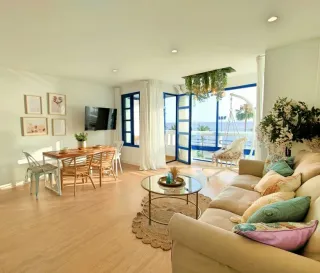

Do you own a property in French Guiana, Martinique or Guadeloupe and wonder whether it’s really earning what it could? Short-term rentals (Airbnb, Booking, Abritel) can generate significantly higher income than a traditional unfurnished or furnished long-term lease, provided you pull the right levers. In this guide, you’ll discover what concretely determines a property’s profitability in the French West Indies and French Guiana, how to calculate your real net income, and how a property management service can make the difference despite its commission.
What determines the profitability of a short-term rental?
Profitability isn’t just about the nightly rate you advertise. It depends on two variables that multiply one another:
- The occupancy rate: the percentage of nights actually booked over the year.
- The average nightly rate (often called ADR, Average Daily Rate): what a guest pays on average.
A property rented at 120 € per night but occupied 40% of the time earns less than one at 95 € occupied 70% of the time. It’s the balance between these two figures, not the advertised rate alone, that builds your annual income. In the French West Indies and French Guiana, both of these levers are strongly influenced by seasonality, location and the quality of the listing.
To project these figures onto your specific property, you can use our property management service + income simulator, which combines these parameters according to your town and your type of accommodation.

Understanding seasonality in the French West Indies & French Guiana
Tourist demand in the region is marked by strong seasonality that every owner needs to anticipate.
- High season: broadly from December to April, peaking around the end-of-year holidays, Carnival and mainland French school holidays. Demand is strong, rates can climb and occupancy is high.
- Low season: summer and the wet season (the rainy period) see visitor numbers drop. In French Guiana, however, space-industry activity and business travel can still support demand during certain periods.
A common mistake is to apply a fixed rate all year round. You then leave money on the table during high season (underpricing) and sit empty during low season (overpricing). Dynamic pricing, adjusted week by week or even day by day according to local events and the competition, is one of the most profitable levers at your disposal.
Concrete levers to increase your income
Several factors under your direct control raise both occupancy and the average rate.
The quality of the listing and the photos
This is the guest’s first filter. Professional photos that are bright and polished noticeably increase the click-through rate and therefore the booking rate. A clear title, a complete description (amenities, view, distance to the beach, air conditioning, wifi) and a meticulously up-to-date listing reassure guests and justify a higher rate.
Guest reviews
Your rating and the number of reviews weigh heavily in the platforms’ rankings and in the decision to book. Aiming for a rating close to 4.7/5 requires consistency: impeccable cleaning, responsiveness, a thoughtful welcome. A well-rated property can often command a higher rate than an equivalent but lower-rated competitor.
Multi-channel distribution
Listing only on Airbnb means depriving yourself of part of the demand. Distributing simultaneously across several platforms (Airbnb, Booking, Abritel) with synchronized calendars increases visibility and occupancy, without any risk of double booking when synchronization is properly managed.
Responsiveness and the welcome
A short response time improves your ranking and your conversion rate. A smooth arrival experience (in person or self-service with a key box and clear instructions) generates better reviews, which in turn feed occupancy. It’s a virtuous circle.
How to calculate your real net income
The advertised gross income is misleading: what counts is what stays in your account. Here’s the formula to keep in mind.
Net income = gross income − platform fees − cleaning − running costs − management commission
Let’s break down each item:
- Gross income: the total collected from bookings over the year.
- Platform fees: the commission charged by Airbnb, Booking, etc. (the order of magnitude varies depending on each platform’s model).
- Cleaning: the cost of cleaning and linen between each stay (often partly passed on to the guest, but not always in full).
- Running costs: water, electricity, internet, insurance, subscriptions, minor maintenance, the tourist tax to remit.
- Management commission: if you delegate management, generally a percentage of revenue.
Illustrative example (for guidance only)
Let’s take a fictional apartment occupied for part of the year:
- Annual gross income: 18,000 € (example)
- Platform fees: − 1,800 €
- Cleaning (net of pass-through): − 1,500 €
- Running costs: − 2,400 €
- Management commission (20%): − 3,600 €
- Estimated net income: ≈ 8,700 €
These figures are illustrative examples, provided solely to show the logic of the calculation. They in no way constitute a promise of return: the actual result depends on your property, its location, the season and the market. No profitability is guaranteed.